
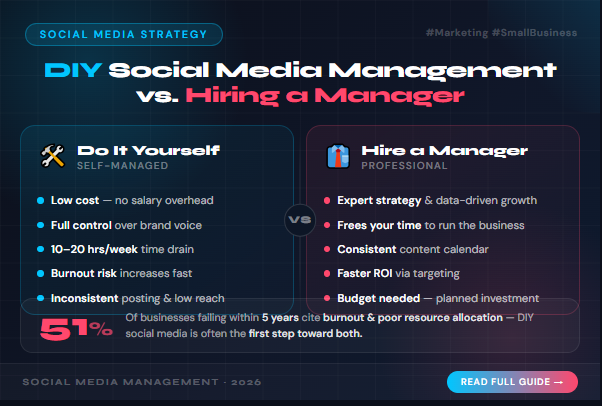

In 2026, the digital marketplace is too fast, too loud, and too demanding for “part-time” efforts. According to recent industry data, more than 51% of businesses that fail in their first five years cite “burnout” or “poor resource allocation” as a primary factor. Trying to manage your own socials is often the first step toward both.
Founders treat social media like a side task until it starts draining their productivity. This honest comparison exposes the “intern-level” mistakes of DIY management and provides a clear pricing guide for outsourcing. Suit up to explore how to reclaim your time while turning your social platforms into high-ROI assets that actually convert, rather than just taking up space on your phone.
Why Doing It All Yourself is Costing You Your Business
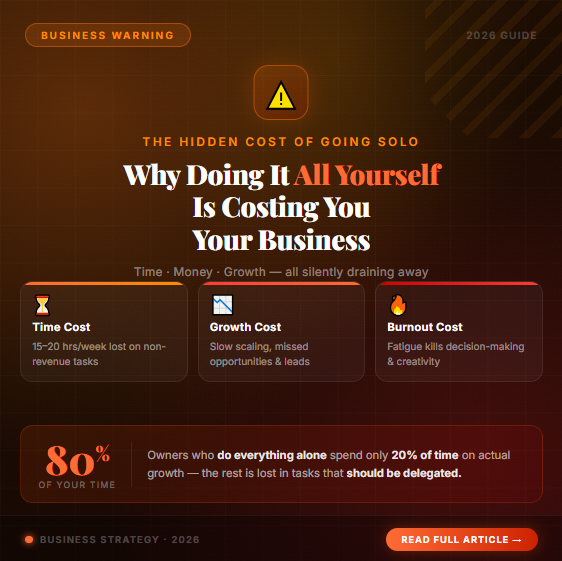
There is a romanticized image of the modern founder: a coffee in one hand, a smartphone in the other, effortlessly “building a brand” between meetings. It looks like freedom. Saving money feels like the smart move. Staying close to the customer seems like the right instinct.
But if we pull back the curtain, the reality is much uglier. It’s 11:00 PM on a Tuesday, and you’re staring at a half-finished caption, wondering if “growth” is still a thing or if you’ve officially become your own out-of-touch uncle. You haven’t looked at your actual business strategy in days because you’ve been trapped in a scrolling spiral, trying to figure out why your last three posts got exactly zero engagement.
Choosing between DIY social media management and hiring a professional can’t be just a budget decision, but a decision about where you belong in your company. Are you the visionary, or are you the unpaid intern?
The False Economy: Let’s Uncover the Hidden Costs of DIY Marketing
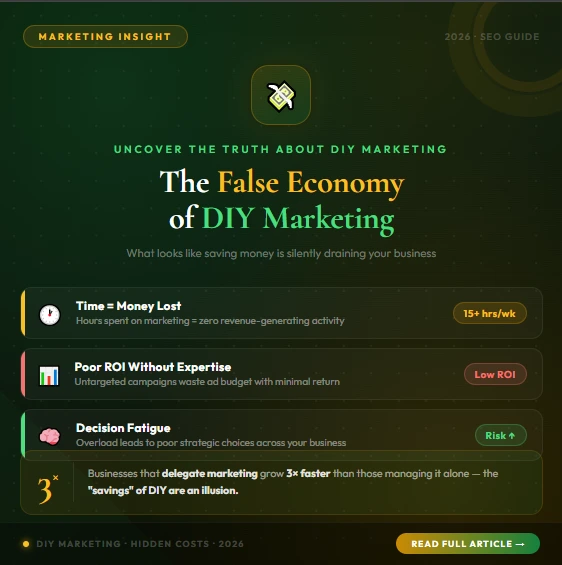
The biggest lie founders tell themselves is “social media is free.” It is only free if your time has zero value.
When you calculate the hidden costs of DIY marketing, you have to look at the “Opportunity Cost.” If you spend five hours a week trying to design graphics in Canva, writing captions, and replying to comments, that is five hours you aren’t spending on product development, high-ticket sales, or scaling your operations.
If your hourly value as a CEO is $100, and you spend 20 hours a month on social media, you aren’t “saving” money. You are spending $2,000 a month to be a mediocre content creator. When you add the cost of subscriptions for time saving social media tools, stock footage, and the inevitable “boosted post” that goes nowhere, the DIY route becomes an expensive hobby rather than a growth strategy.
The Math of Growth: Measuring Social Media Manager ROI 2026
In 2026, engagement is a vanity metric; conversion is the only metric that pays the bills. A professional doesn’t just “post content.” They build a funnel.
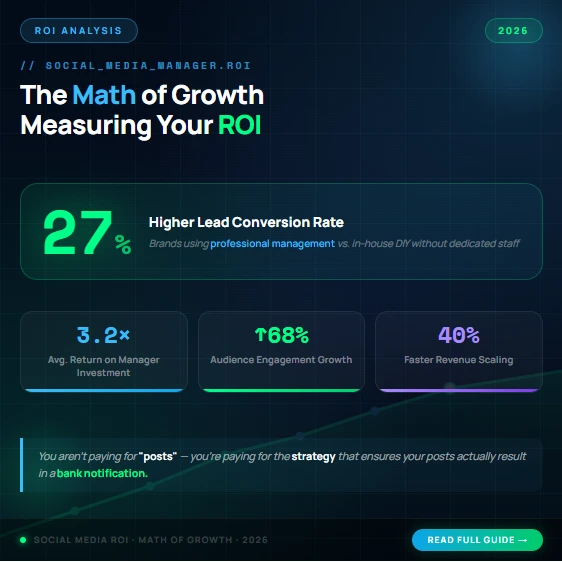
The social media manager ROI 2026 is calculated by the distance between a stranger seeing your post and that stranger becoming a lead. A professional understands “social search”, optimizing your content so that when people search for solutions on TikTok or Instagram, your brand is the answer.
Research from HubSpot’s 2026 State of Marketing shows that brands using professional management see a 27% higher lead conversion rate than those managing in-house without dedicated staff. You aren’t paying for “posts”; you are paying for the strategy that ensures your posts actually result in a bank notification.
The Brutal Truth About Social Media Management Pricing Guide
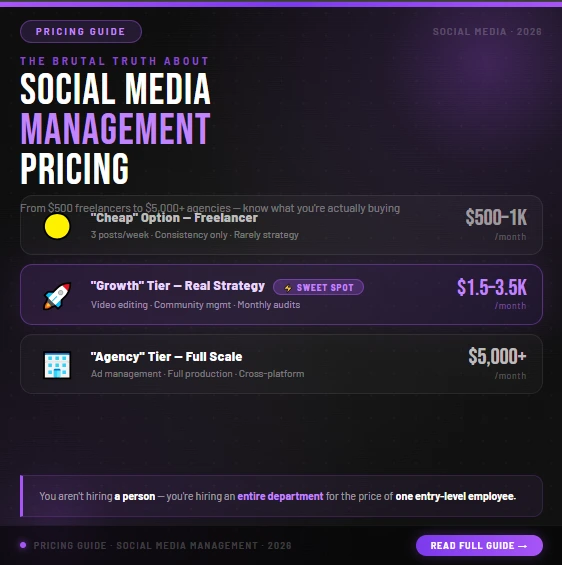
Let’s talk about the elephant in the room: money. Most businesses stay DIY because they are terrified of a $3,000-a-month retainer. But if you look at a social media management pricing guide, you realize there is a spectrum.
- The “Cheap” Option ($500–$1,000): Usually a freelancer who posts 3 times a week. You get what you pay for, consistency, but rarely strategy.
- The “Growth” Tier ($1,500–$3,500): This is where social media strategy for businesses actually happens. You get video editing, community management, and monthly performance audits.
- The “Agency” Tier ($5,000+): Full-scale production, ad management, and cross-platform dominance.
When you compare this to outsourcing social media costs, you have to factor in that an agency comes with its own software, its own team of specialists, and its own accountability. You aren’t just hiring a person; you are hiring an entire department for the price of one entry-level employee.
Efficiency vs. Soul: Social Media Automation vs Manual Posting
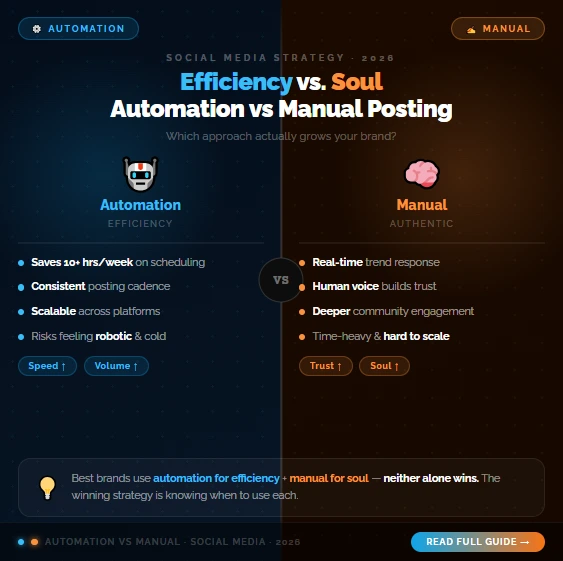
The DIYer loves the “Post and Ghost” method. They use social media automation vs manual tools to blast the same boring graphic to five different platforms at once.
The spicy truth? Your audience can smell automation from a mile away. In 2026, algorithms penalize “lazy” cross-posting. A professional understands the social media workflow for startups, they know that a video that works on Reels will fail on LinkedIn unless it is reframed, re-captioned, and re-timed.
Automation should be used to handle the mechanics of posting, but a human must handle the nuance of the conversation. If you are just scheduling 30 days of “Happy Monday” posts, you aren’t managing a brand; you’re managing a digital graveyard.
The Mental Load of Managing Multiple Social Platforms
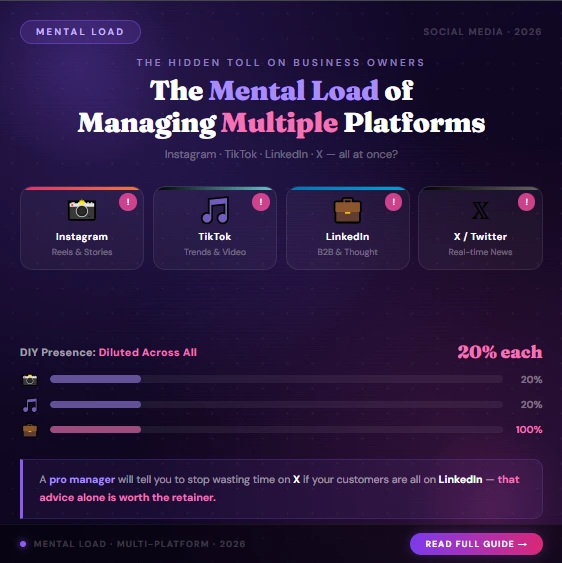
If you think you can handle Instagram, TikTok, LinkedIn, and X simultaneously while running a business, you are setting yourself up for a nervous breakdown. Managing multiple social platforms requires more than just “switching accounts.” It requires switching personas.
Each platform has its own culture, its own “slang,” and its own peak hours. When you DIY, you end up with a “diluted presence.” You are 20% effective on five platforms instead of 100% effective on the one that actually matters. A professional manager ruthlessly prioritizes. They will tell you to stop wasting time on X if your customers are all on LinkedIn. That advice alone is worth the retainer.
Why a Social Media Strategy for Businesses is Not “Just Posting”
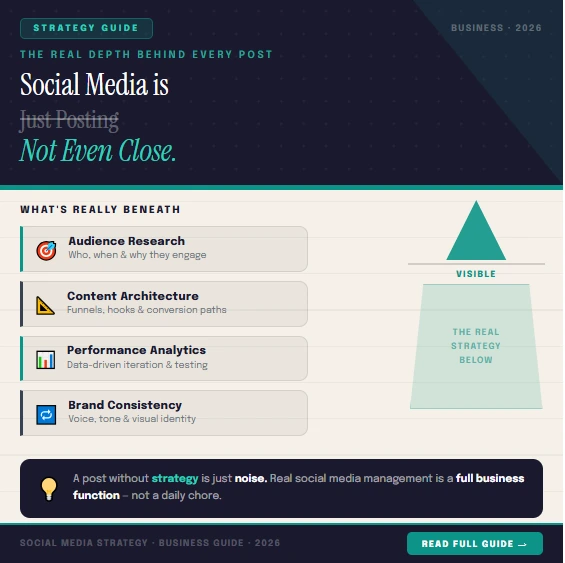
“What should I post today?” is the question that kills brands. If you are asking that, you’ve already lost. A social media strategy for businesses is a 6-month roadmap. It aligns your content with your sales cycle. If you have a launch in October, the “magic” starts in July with teaser content and authority building. DIYers don’t have the bandwidth for this kind of foresight. They are too busy trying to find a trending audio before it becomes cringe.
The Final Verdict: Who Wins the DIY vs. Pro Battle?
If you are a solo-founder with $0 in revenue and 18 hours of free time a day, stay DIY. Use time saving social media tools, learn the basics, and build your own voice. It is a great way to understand your audience.
But the moment your time is worth more than the cost of a manager, continuing to DIY is an act of self-sabotage. You are holding your business back because you are afraid to let go of the steering wheel.
If you’re at that point, this guide on affordable social media management services for freelancers will help you make the smartest next move without overspending.
The benefits of professional social media aren’t just “better pictures.” It is the freedom to focus on what you actually love. It is the peace of mind knowing that while you sleep, your brand is engaging, growing, and selling.
Why SocialzRank
At SocialzRank, we don’t believe in “vanity management.” We believe in growth. Our team has seen too many brilliant founders drown in the noise of their own feeds. We don’t just “post”; we protect your time and amplify your voice. You built the business to be a leader; it’s time you stopped acting like the social media intern. Let’s get you back to the work that actually leads your brand towards the global unicorn club!