

Table of Content
- Introduction
- Is Traditional Search Dead? Why “SEO” Has Shifted to AEO
- The 5 Pillars of Intent-Based Discoverability
- Why Is My Website Not Ranking on Google? The 2025 Algorithm Hangover
- The Small Business Toolkit: Free SEO Tools USA vs. Professional Strategy
- Reality Check: How Long Does SEO Take in an AI World?
- SocialzRank: Engineering Inevitability
Introduction
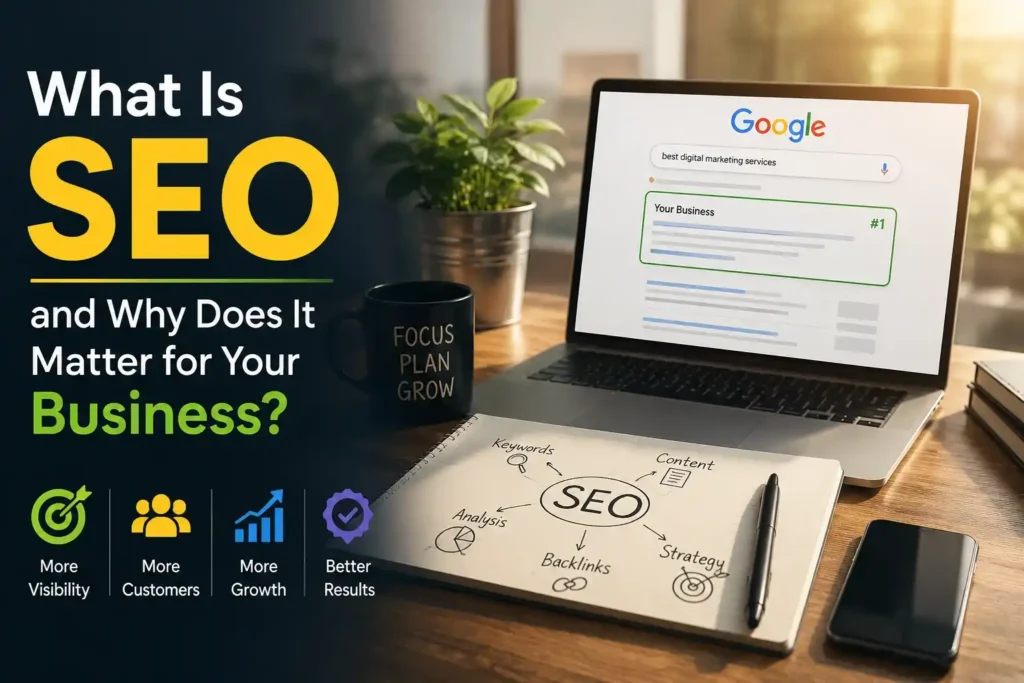
What is SEO? It is the deliberate process of engineering your digital footprint so that search engines and AI models recognize your website as the definitive answer to a user’s specific problem. For a deeper breakdown of modern ranking systems, read our complete SEO guide for businesses in the USA. As the general definition of SEO is the systematic practice of aligning web content with the technical requirements and algorithmic intent of search platforms to capture high-value, organic user traffic without paying for ad placement.
In 2026, it is no longer about tricking a basic algorithm with repetitive phrases; it is the ultimate foundation of intent-based discoverability. If your business is invisible on the major search surfaces, you are effectively conceding your entire market share to the competitors who chose to invest in strategic SEO optimization services while you relied on temporary ads.
Is Traditional Search Dead? Why “SEO” Has Shifted to AEO
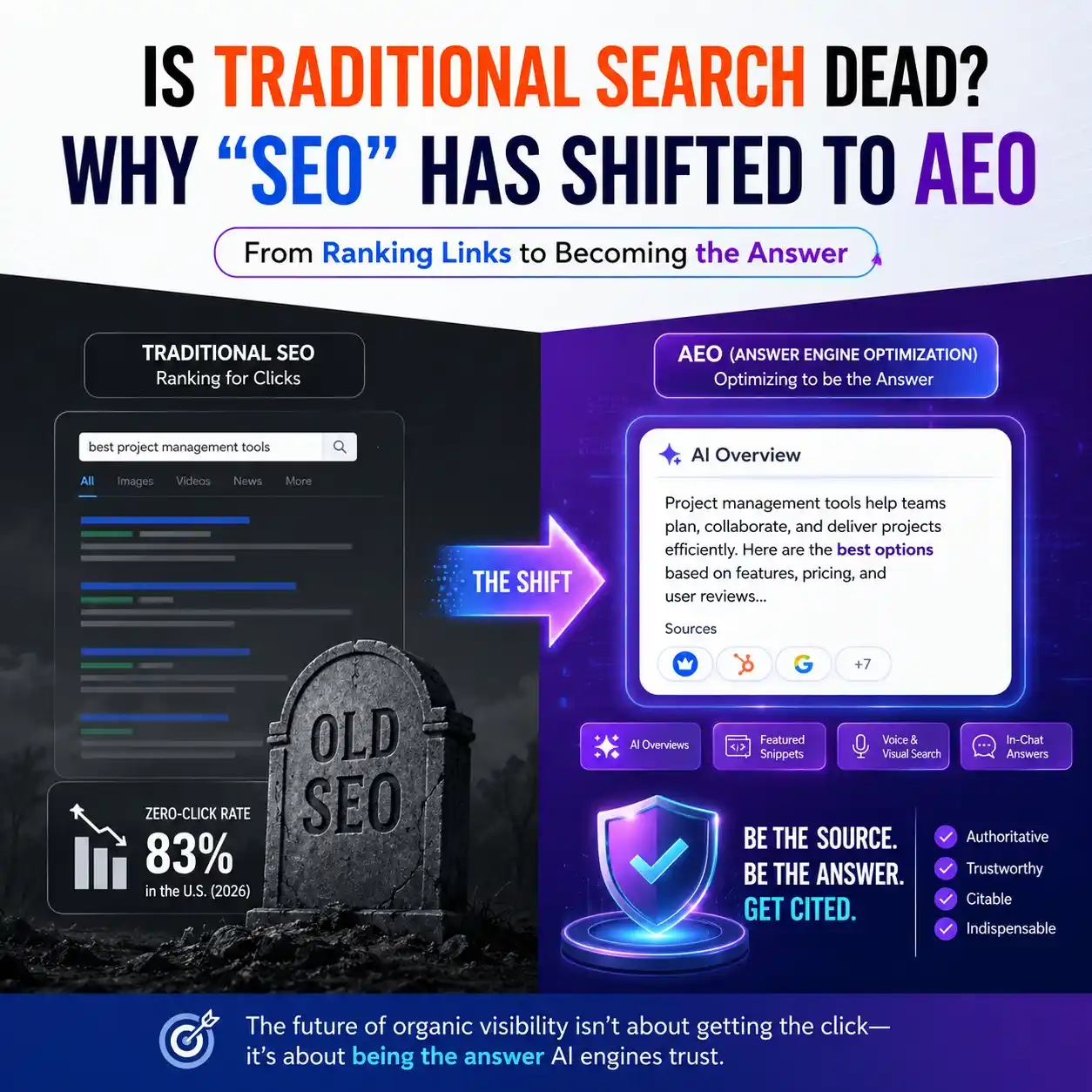
The digital marketplace has fractured. The legacy definition of what SEO is used to revolve exclusively around ranking a blue link on a desktop screen. Today, the game is entirely driven by answer engine optimization and the rapid rise of search-generative experience. Users no longer want a list of links to sort through; they demand immediate, synthesis-driven answers directly on their screens.
This structural evolution means that traditional click-through dynamics have changed forever. According to the 2026 ClickVision Zero-Click Search Report, informational queries across the United States now show an average zero-click rate of 83%.
This means that if your content is not built for answer engine optimization, your brand will be completely bypassed by AI overviews that scrape the web for the absolute highest-quality sources. To survive, your organic strategy must pivot from simply chasing raw traffic to becoming an undeniable, authoritative data source that AI engines trust and cite.
The 5 Pillars of Intent-Based Discoverability
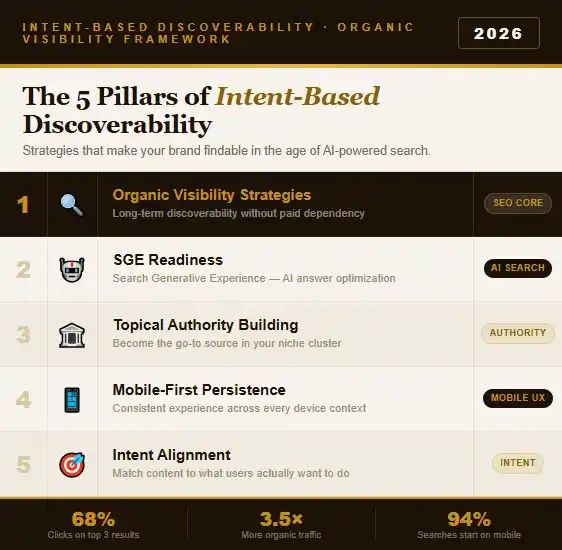
Succeeding in the modern search ecosystem requires a complete rejection of old-school keyword stuffing. To build a brand that commands attention, you must master five distinct areas of modern digital distribution.
1. Organic Visibility Strategies for 2026
Modern organic visibility strategies require a multi-format approach. You cannot rely solely on a single text block. Your website must integrate clear, structured text, interactive elements, and highly optimized vertical video blocks. When Google indexes your page, it looks for the most complete media mix that can effectively satisfy a user’s intent across both mobile and desktop interfaces.
2. Search Generative Experience (SGE) Readiness
To optimize for search generative experience, your pages must be explicitly organized for machine consumption. This means using microdata schemas, bulleted summaries, and immediate, declarative definitions at the start of every informational section. If an AI engine cannot parse your core thesis within 200 milliseconds of crawling your page, then it will pull a clearer summary from a competitor..
3. Topical Authority Building
Google no longer ranks isolated web pages; it ranks entire websites based on their proven expertise. Topical authority building is the process of creating interconnected content ecosystems that cover a specific subject from every conceivable angle. By answering the primary question, the secondary question, and the deep technical queries across a cluster of related articles, you prove to the algorithm that your domain is an undisputed subject matter expert.
4. Mobile-First Persistence
With 72% of all US digital attention and search behavior locked into mobile devices, your desktop design is functionally irrelevant. Search engines use mobile-first indexing. This is why modern brands are prioritizing mobile-first SEO optimization for businesses to maintain consistent rankings and engagement. meaning they evaluate your site’s authority based entirely on how it performs on a standard smartphone. High layout shifts, bloated code, or hidden text on mobile versions will permanently cripple your visibility.
5. Intent Alignment
Keywords are just symbols; intent is the economic reality. You must classify your target queries into clear buckets: informational, commercial, or navigational. Trying to force a transactional product page to rank for a purely informational query is a waste of time. Your content structure must match exactly what the user expects to accomplish at that specific moment in their buying journey.
Why Is My Website Not Ranking on Google? The 2025 Algorithm Hangover
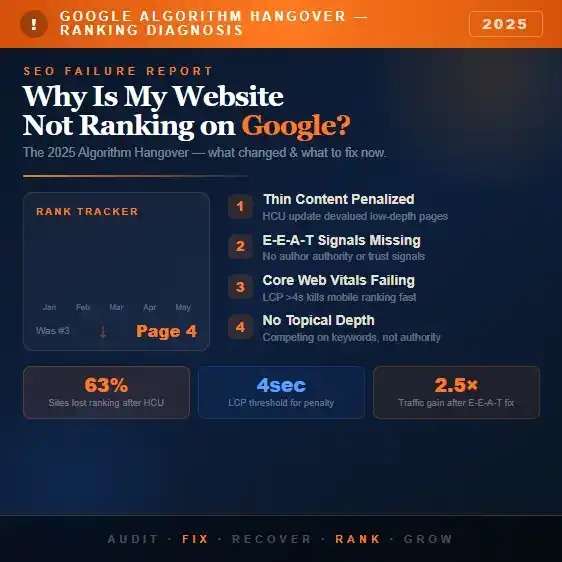
If you are constantly asking yourself, “Why is my website not ranking on Google?” you are likely suffering from the structural fallout of recent algorithmic core adjustments. The Google algorithm update 2025 environment radically altered how the search engine filters out low-value content. Specifically, the landmark “Authenticity Update” systematically targeted and deindexed domains that relied on mass-produced, unedited AI content that offered no real-world value.
The algorithm now uses advanced semantic filters to evaluate the uniqueness of your data. If your site simply repeats the same concepts, definitions, and structures found on the top ten ranking sites, then Google has a direct mandate to suppress your visibility.
A persistent website not ranking Google penalty is almost always a sign that your brand is lacking genuine user-experience signals, verified author credentials, or original data points that a machine cannot easily manufacture.
The Small Business Toolkit: Free SEO Tools USA vs. Professional Strategy
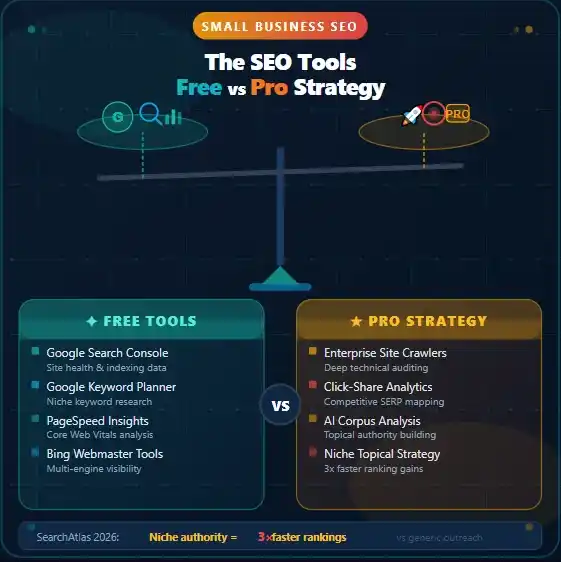
Many businesses fall into the trap of thinking they need a million-dollar software budget to establish baseline visibility. The truth is that you can build an incredibly robust foundation using free SEO tools USA business owners have access to right now. Tools like Google Search Console, Bing Webmaster Tools, and Google Keyword Planner show you how search engines see your site, its health, indexing, and overall performance in a clear, direct way.
The Modern Search Optimization Toolkit
| FREE TOOLS | PAID TECH |
| Google Search Console | Enterprise Crawlers |
| Google Keyword Planner | Click-Share Analytics |
| PageSpeed Insights | AI Corpus Analysis Platforms |
When executing keyword research and small business strategies on a budget, your goal should be to uncover underserved niches. Avoid high-volume, generic industry terms that are dominated by multi-billion-dollar conglomerates. Instead, use your search console data to find specific, multi-word user problems where the current search results are weak or outdated.
According to 2026 market data from SearchAtlas, brands that prioritize niche topical authority building see measurable ranking improvements 3x faster than companies that try to build general domain metrics through random outreach.
Reality Check: How Long Does SEO Take in an AI World?
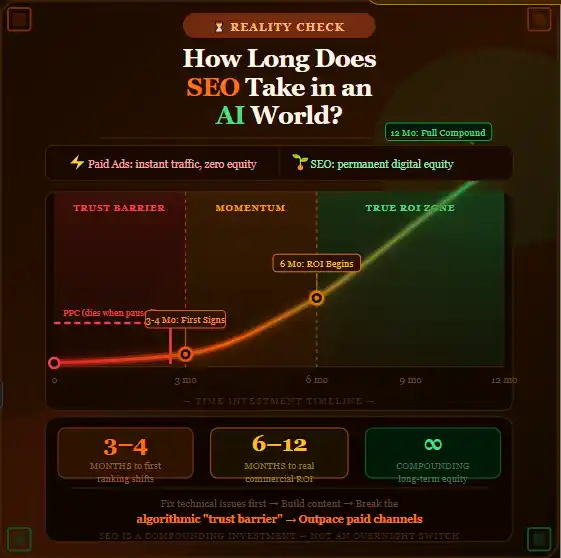
The honest answer to how long does SEO take is that it is a compounding long-term investment, not an overnight switch. While a paid ad campaign can drive traffic within five minutes of launching, that traffic vanishes the second your credit card is turned off. SEO, by contrast, builds permanent digital equity.
The duration for which a website will start seeing changes is between 3 to 4 months for a new website in the United States.
True commercial ROI, where organic lead generation consistently outpaces your paid acquisition channels, typically materializes between the 6- and 12-month window. If your site suffers from an initial website not ranking on Google due to a delay, it is often due to the algorithmic “trust barrier.” Before increasing your ranking at Google, technical issues have to be sorted out and new content added.
SocialzRank: Engineering Inevitability
Knowing what SEO is conceptually will not scale your business; ruthless, precision-engineered execution will. At SocialzRank, we reject legacy marketing assumptions and build advanced data moats that protect and grow your market share. Moreover, our team builds customized, technical infrastructure, aggressive digital PR frameworks, and high-impact organic visibility strategies that align perfectly with the search realities of 2026. We remove anything that is likely to reduce conversions and place your brand within the right channels to reach valuable customers. To better understand the long-term strategies behind modern search growth, explore our Complete Guide to SEO for Businesses in the USA (2026)
Frequently Ask Questions
Traditional SEO focuses on optimizing web pages to rank high within search engine results pages for human users to click. Answer engine optimization focuses on formatting your data so clearly that AI engines can easily scrape, understand, and use your content as the direct conversational output for a voice or chat query.
Enterprise brands can rank for broad terms based on sheer domain authority. Small businesses must focus on hyper-specific, long-tail problem keywords where user intent is high but competitor content is thin. Winning a small, high-conversion niche is vastly more profitable than being invisible for a major head term.
Your core strategy should never change if it is focused on genuine human value. Algorithmic updates are designed to eliminate shortcuts, spam, and low-quality automation. If you focus on clean technical site architecture, original data, and comprehensive topic coverage, updates will generally boost your visibility rather than hurt it.
Yes, for foundational diagnostic monitoring, free SEO tools USA, like Google Search Console, are flawless. However, as your business scales, you will eventually require advanced, paid competitive intelligence platforms to analyze competitor content gaps and track real-time click-share distribution.
Great content is useless if the search engine cannot find or read it. A severe website not ranking Google issue is frequently tied to technical blockages: incorrect robots.txt directives, indexation loops, poor mobile optimization, or extreme server lag times that cause search bots to abandon their crawl.
While ranking signals manifest within 90 days, consistent organic lead generation usually requires 6 to 12 months of sustained optimization. This timeline depends on your industry's competitive density and the speed at which you build clean backlink profiles.
SGE changes the user journey by providing direct answers instantly. To capture value here, your content must be cited as a source inside that AI summary box. This requires absolute factual precision, bulleted takeaways, and highly structured schema markup.
Topical authority decays if your content becomes outdated. You must review your core content assets at least twice a year to inject updated industry statistics, answer new user queries, and verify that all internal links to your supporting articles are functioning perfectly.