
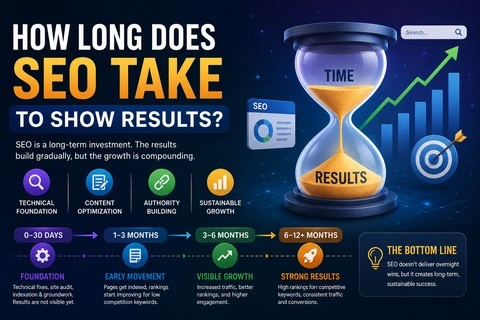

If you enter an optimization campaign expecting overnight traffic spikes, you are setting your business up for financial frustration. Search engines do not operate on instantaneous feedback loops. Therefore, knowing how long does SEO take requires understanding that search algorithms utilize historical caching, algorithmic verification buffers, and deep data processing cycles to evaluate site modifications. If you’re a business owner looking for the big picture on rankings, timelines, and long-term organic growth, our full SEO guide for USA businesses breaks down how technical SEO, content planning, local visibility, and authority building all work in 2026.
Likewise, to build a sustainable acquisition asset, you must look past basic vanity metrics. Instead, a highly profitable approach focuses on systematic infrastructure upgrades that yield predictable, compounding revenue over time. For an enterprise or growing brand, determining how long does SEO take boils down to a three-phase operational cycle spanning from initial code indexation to mature, high-intent conversions.
Phase 1: The Initial Technical Signals (Days 1–30)
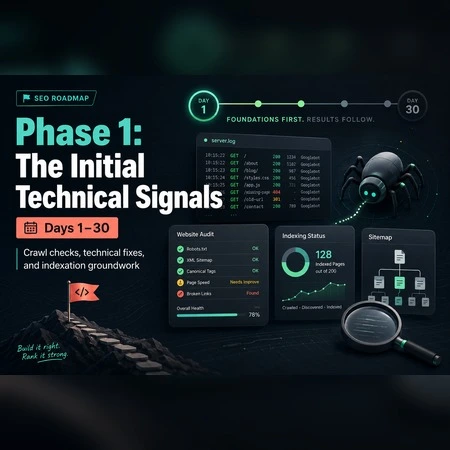
The first thirty days of a strategic optimization campaign are completely invisible to the average business owner. During this initial setup window, your engineering efforts focus on correcting foundational crawl errors and code bloat. To monitor performance at this early stage, you must implement rigorous crawl frequency tracking. This involves analyzing your server logs daily to see how fast search engine spiders discover, download, and parse your updated code assets.
[Deploy Optimized Code] ──> [Crawl Frequency Tracking] ──> [Log File Verification]
As search engine user agents increase their fetch velocity, you will start noticing adjustments within your diagnostic software. In particular, tracking early Search Console impressions is the primary method to verify that your optimizations are taking root. Long before those impressions convert into organic clicks, a steady upward slope in impression data proves that search crawlers are testing your pages for a broader pool of contextual queries.
Why Google Freezes Fresh Infrastructure Upgrades
The primary barrier during this opening month is the natural algorithm processing delay. If you fix a technical error or change your site structure, search engines won’t instantly update their global index. Instead, they need time to crawl, process, and verify those updates. In a sweeping 2026 data study tracking millions of new URLs, a multi-week pattern has been seen. For businesses, search engines typically take some weeks to reassess updated site structures. Then they use those structural changes on live search results.
Therefore, utilizing precise crawl frequency tracking allows your team to confirm that bots are digesting the modifications despite this systemic algorithm processing delay. In other words, by isolating these early Search Console impressions, you gain data-driven validation that your platform is shedding its historical architecture limitations. If your business needs an expert to help guide you through this technical setup stage, our professional search engine optimization services can help you identify crawl issues, improve your site structure, and build a stronger foundation for long-term rankings.
Phase 2: Indexation and Relevance Traction (Days 31–90)
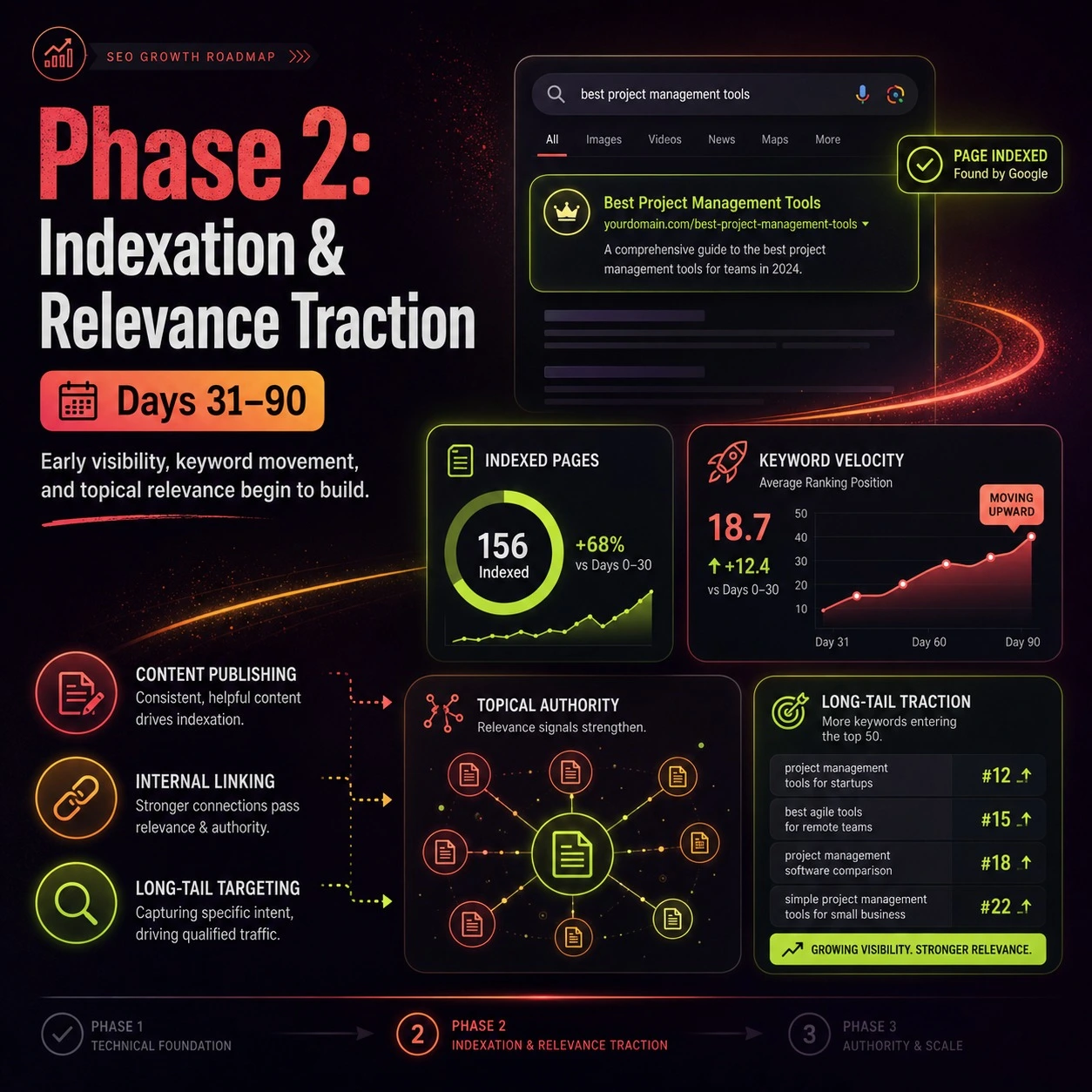
Once the initial indexation delay clears, your platform enters the secondary stabilization stage. At this point, this is where your site begins capturing initial market share by locking down highly specific, transactional search terms. Securing early long-tail traction serves as an operational proof-of-concept for your keyword strategy, pulling in buyers who use longer, high-intent search strings.
[Technical Stabilization]
│
┌─────────────┼─────────────┐
▼ ▼ ▼
[Long Tail Traction] [Keyword Velocity] [Topical Authority]
└─────────────┬─────────────┘
▼
[Relevance Stabilization]
To accurately score this phase, you must monitor your keyword velocity metrics. These metrics track the speed and volume of your target terms as they climb out of deep indexation positions and move toward the primary search views. If your keyword velocity metrics show consistent upward momentum across secondary content pages, it proves that your overall directory health is strengthening.
Deploying Interlinked Content Networks
At the same time, your team must execute strict topical authority timelines. Building authority requires publishing exhaustive, tightly linked content assets that cover every sub-topic within your niche. That’s exactly why a pillar-and-cluster SEO model is so crucial for US businesses, with the pillar page acting as the central strategic hub and supporting articles like this one answering specific questions about SEO timelines, indexing, and ranking growth. The speed at which you deploy these assets determines your specific topical authority timelines.
As search engines process these comprehensive content blocks, your long tail traction accelerates, as a result, which provides a major boost to your core keyword velocity metrics. This collective data validation indicates that search engines no longer view your site as an isolated homepage, but rather as a highly relevant niche database.
Phase 3: The Growth Threshold (Days 91–180+)
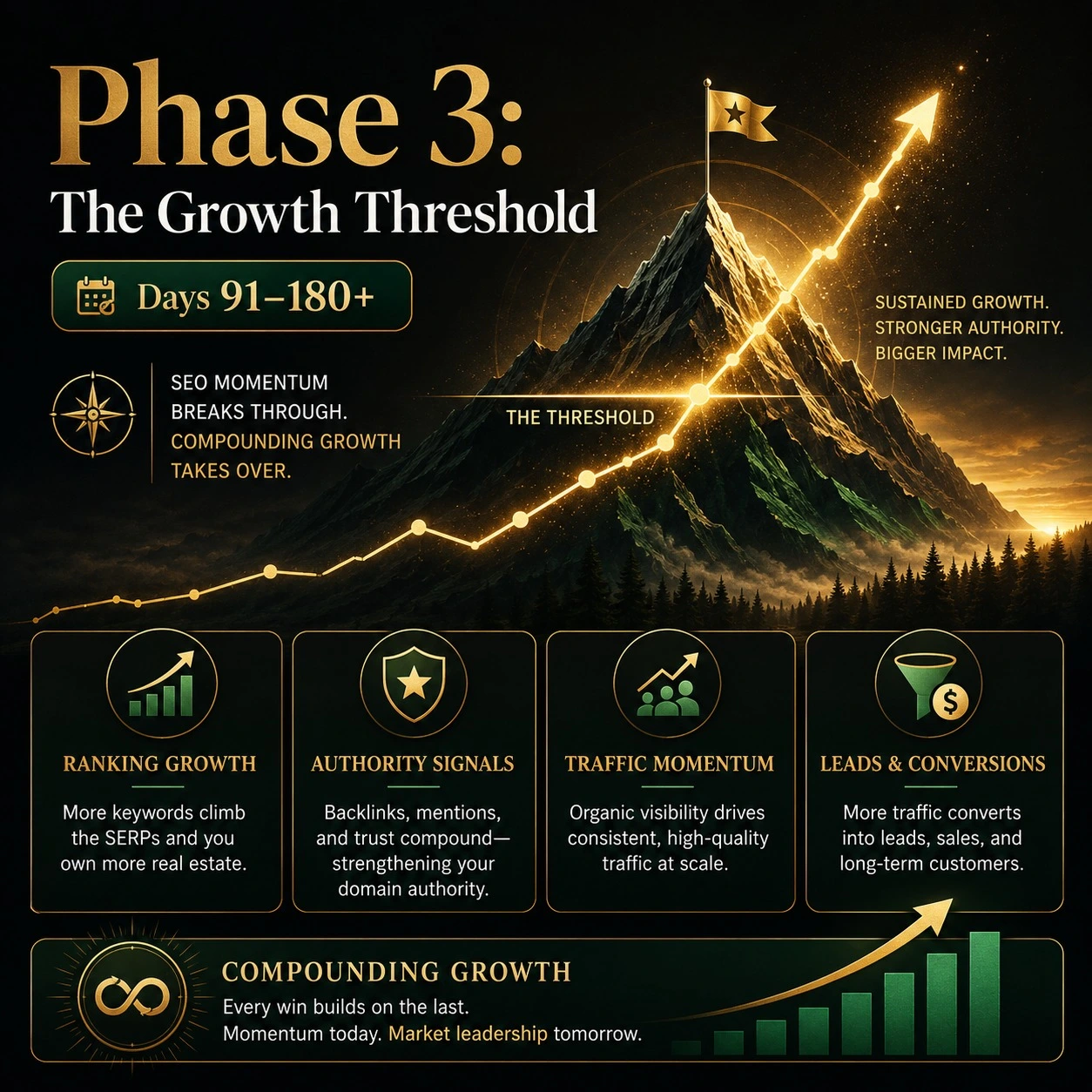
The real transformation occurs after day ninety, as your optimized assets move through final ranking maturity phases. This is the stage where search engines finalize your asset positioning based on real-world user engagement metrics and consolidated backlink profiles. Moving through these distinct ranking maturity phases allows your pages to cement their positions at the top of high-volume search results.
| Campaign Phase | Primary Data Focus | Key Operational Target | Expected Growth Behavior |
| Days 1–30 | Server logs & initial impressions | Maximize search bot access velocity | Latent indexation changes |
| Days 31–90 | Transactional long-tail metrics | Build complete topical content blocks | Linear visibility gains |
| Days 91–180+ | Macro visibility & revenue conversion | Capture high-volume terms | Exponential compounding growth |
To visualize this macro expansion, you must utilize continuous search visibility tracking. By aggregating data across independent keyword monitoring software, your search visibility tracking provides a high-level view of your expanding market share against legacy competitors. This data-driven visibility serves as the catalyst for organic traffic compounding, where your historically ranked pages generate the authority needed to rank new assets almost instantly.
Mastering Conversion Lag Dynamics
The final operational layer is a detailed conversion lag analysis. A business owner must realize that search visibility growth does not perfectly mirror your weekly sales reports; a natural delay occurs between a keyword hitting page one and a consumer completing a purchase cycle. Running a continuous conversion lag analysis prevents you from making short-sighted adjustments to an asset that is actively building traction.
A 2026 enterprise performance report reveals that competitive domains require an average of 120 to 180 days to fully overtake stagnant legacy competitors through rigorous data optimization. Once your assets break past this threshold, organic traffic compounding triggers a self-sustaining customer acquisition engine.
Understanding how long does SEO take requires moving away from vanity metrics and treating search visibility as a structured engineering project. Executing a campaign without a deep understanding of how long does SEO take guarantees that you will abandon your strategy right before your assets hit the exponential growth phase.
If you’re planning a full organic growth campaign, start with our pillar resource, The Complete Guide to SEO for Businesses in the USA (2026). It breaks the entire SEO system down including technical optimisation, content strategy, local SEO, authority building and performance tracking for American businesses.
SocialzRank: Engineering Accelerated Organic Capital
Stop wasting your marketing capital on agencies that blame slow search algorithms for their lack of performance while delivering zero tangible progress reports.
At SocialzRank, we treat search engine optimization as a predictable, data-driven revenue channel. Strict crawl budgets and rapid search updates drive organic growth. It’s a competitive digital framework. Relying on stale content strategies can quickly blow through your acquisition budget. We don’t hide behind generic timeline excuses. Instead, we map your technical optimisation targets, clean your backend rendering pipelines, and improve your indexation speed. That means your business can take market share where it matters.
Frequently Ask Questions
Any agency promising page-one results in thirty days is using high-risk, black-hat techniques that lead to manual penalties. We use forensic site architecture optimization and authoritative content engineering to build safe, permanent search visibility that scales your revenue.
We compress indexation timelines by utilizing direct API indexing requests, building ultra-clean XML sitemaps, and fixing server response bottlenecks. This setup forces search engine crawlers to discover and process your code updates ahead of standard schedules.
Because search engines must route your updated pages through multi-stage caching and validation filters before adjusting live rankings. This delay is why early progress is measured via impression velocity and search log tracking rather than raw traffic data.
No. Automated AI tools generate generic, repetitive copy that fails modern search quality checks. We manually engineer data-driven copy packed with original metrics, custom technical insights, and specific entity nodes to maximize search compliance.
We track backend metrics that correlate directly with digital revenue expansion: crawl budget efficiency gains, target keyword position velocity, long-tail impression growth, and organic conversion actions.
New domains are placed in an algorithmic testing environment for the first 90 days. We minimize this testing window by building out high-intent supporting clusters, giving your new brand the authority to compete with older sites faster.
We need about 2 hours during our initial discovery phase to set up code access permissions. After onboarding, our technical team deploys code optimization patches directly, allowing your internal developers to stay focused on daily business operations.
You retain absolute ownership of your technical assets. Every optimized database structure, custom schema script, and authoritative content asset remains completely yours, confirming your platform continues to generate compounding traffic.