
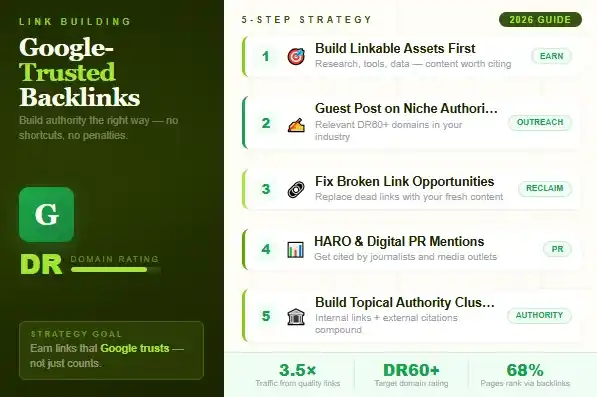

Google’s recent core updates dropped a massive reality check on the SEO industry: the era of scaling bulk, low-tier links to manipulate rankings is dead. If your backlink building strategy relies on automated guest post networks, bloated link exchanges, or unvetted directory lists, you are essentially painting a target on your site for algorithmic devaluation.
When it comes to building an organic footprint that survives ongoing spam filters, Google tracks specific, sophisticated validation metrics. Off-page trust signals have become an integral element of contemporary SEO strategies discussed in our Complete Guide to SEO for Businesses in the USA (2026).
To dominate the SERPs today, businesses must integrate backlink acquisition into broader search engine optimization services focused on authority, relevance, and user trust.
Fatal Flaws the Industry Hides
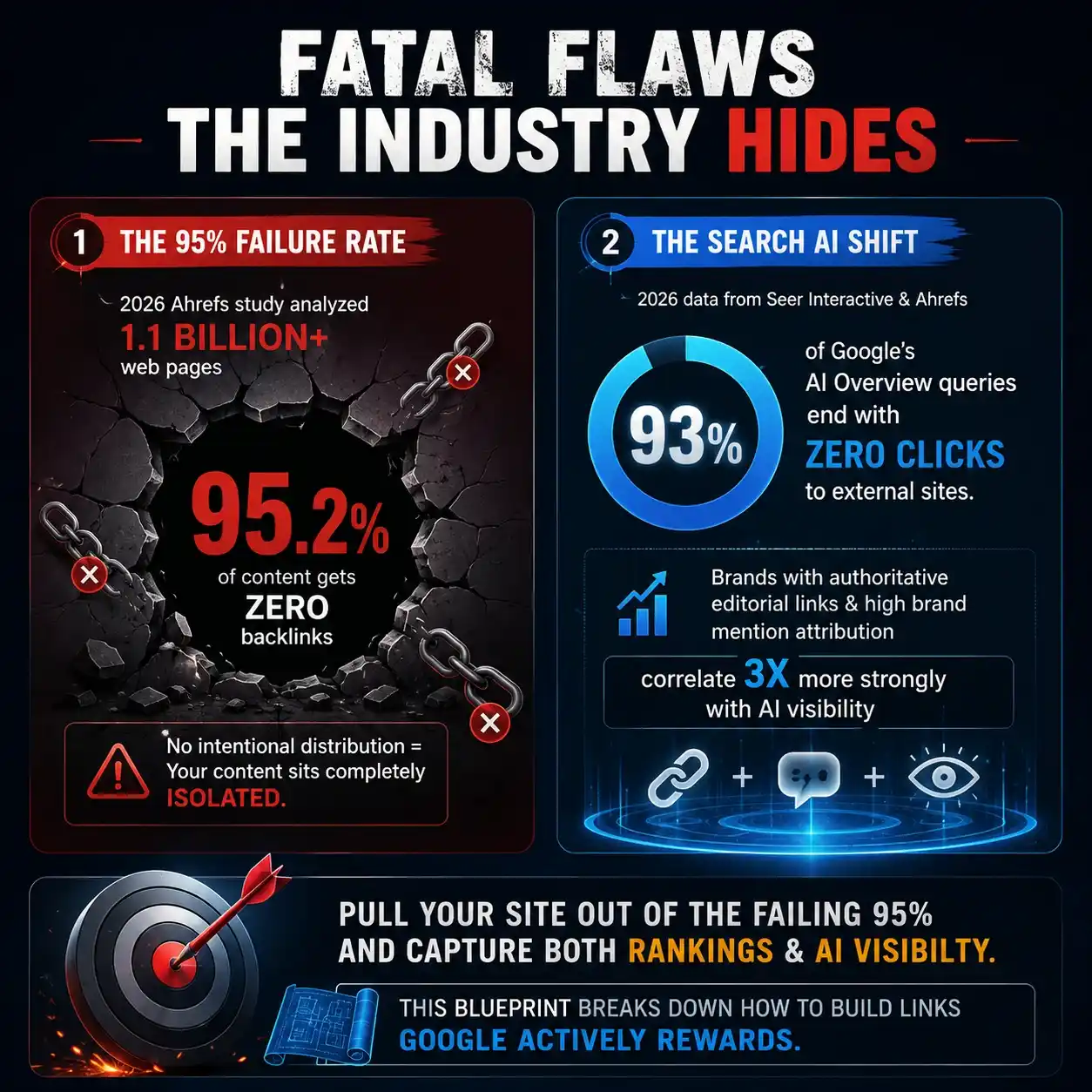
The 95% Failure Rate: A comprehensive 2026 Ahrefs study analyzing over 1.1 billion web pages revealed that 95.2% of all online content receives zero external backlinks. If you build content without an intentional distribution asset, it will sit completely isolated.
The Search AI Shift: According to 2026 data from Seer Interactive and Ahrefs, 93% of Google’s AI Overview queries end with zero clicks to external sites. However, brands with authoritative editorial links and high brand mention attribution correlate 3x more strongly with AI visibility than sites relying purely on legacy link profiles.
If you want to pull your site out of that failing 95% and capture both standard rankings and AI search visibility, this blueprint breaks down how to build links Google actively rewards.
Shift to Digital PR and Editorial Placement Strategy
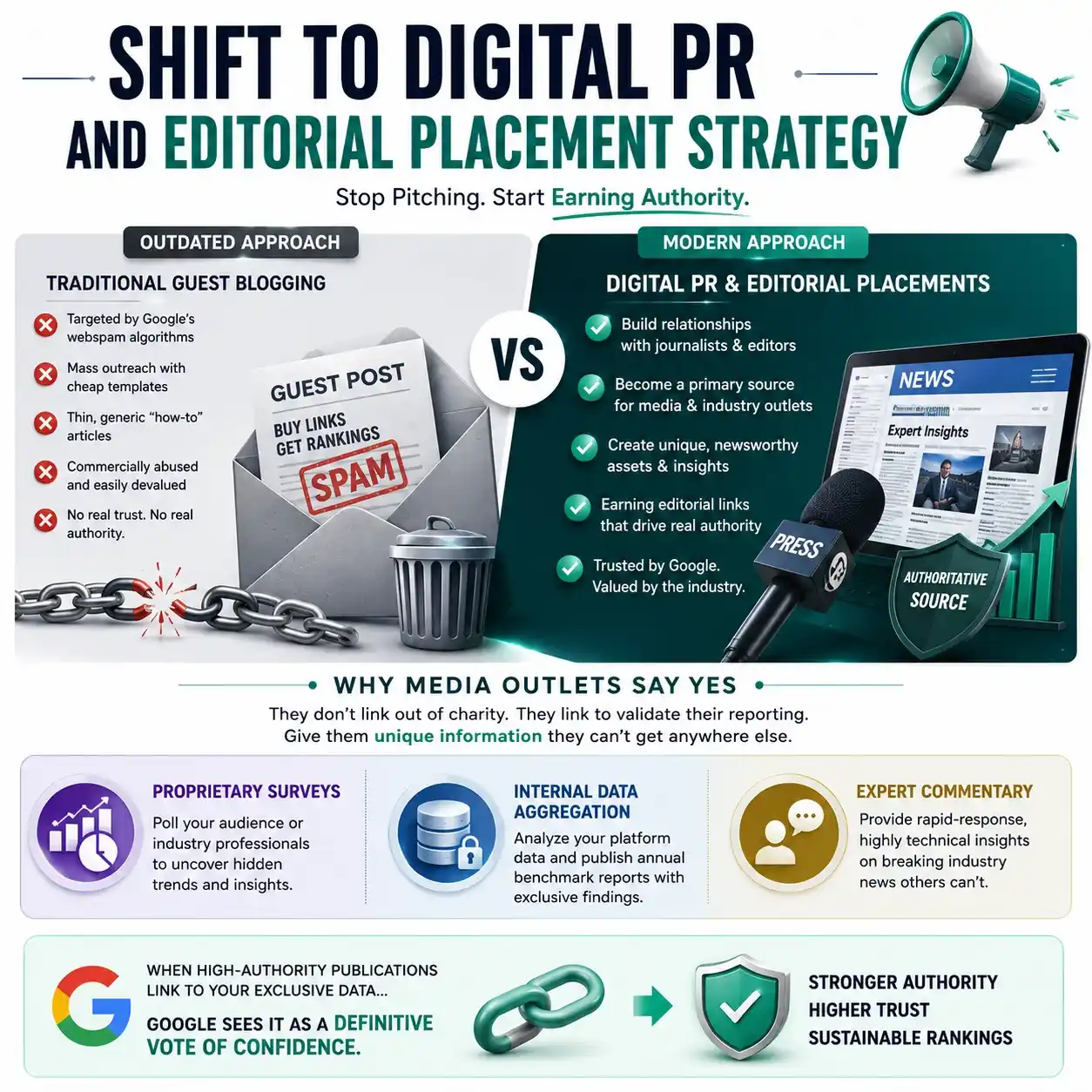
Traditional guest blogging has been aggressively targeted by Google’s webspam algorithms due to widespread commercial abuse. True authority cannot be bought through cheap outreach templates; it must be editorially earned.
A modern editorial placement strategy relies heavily on digital PR outreach. This means instead of pitching thin, generic “how-to” articles to random webmasters, you position your brand as a primary source for journalists, media publications, and tier-one industry outlets.
Why Media Outlets Say Yes
Journalists and editors do not link to external sites out of charity; they link to validate their own reporting. To secure these placements, you must provide unique information gain metrics, insights, unique angles, or proprietary data points that do not exist anywhere else on the web.
- Proprietary Surveys: Poll your user base or industry professionals to uncover a hidden trend.
- Internal Data Aggregation: Anonymize and analyze your own platform data to publish an annual industry benchmark report.
- Expert Commentary: Provide rapid-response, highly technical insights on breaking industry news before generic content aggregators can copy it.
When a high-authority publication links to your asset as the source of this exclusive data, Google views it as a definitive vote of confidence.
Establish Topical Authority Signals and Entity-Based Linking
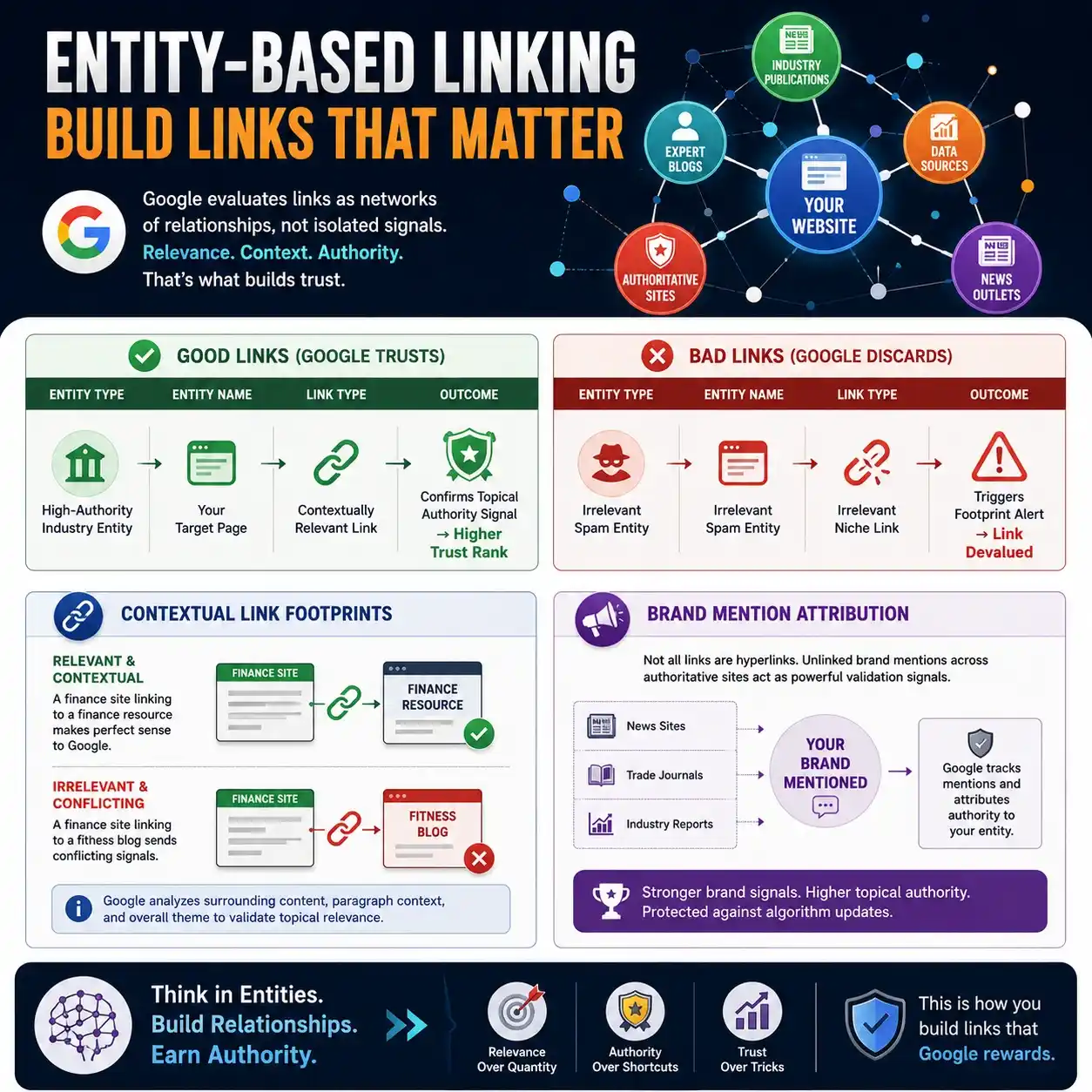
Google no longer evaluates links as isolated ranking signals. Through its knowledge graph and advanced language models, the algorithm treats your link profile as a network of conceptual relationships: a concept known as entity-based linking.
To build links that carry maximum weight, every incoming link must reinforce your site’s core topical focus.
| Entity Type | Entity Name | Link Type | Outcome |
| High-Authority Industry Entity | Your Target Page | Contextually Relevant Link | Confirms Topical Authority Signal ─► Higher Trust Rank |
| Irrelevant Niche Link | Irrelevant Spam Entity | Irrelevant Niche Link | Triggers Footprint Alert ─► Link Devalued |
Contextual Link Footprints
A link from a high-DR finance site pointing to a fitness blog creates a conflicting algorithmic signal. Google looks for a clean, logical connection between the linking entity and your entity. The surrounding text, paragraph context, and overall theme of the referring domain must naturally match your target page to establish a legitimate topical authority signal.
Brand Mention Attribution
Interestingly, a hyperlink isn’t the only way Google measures your authority. Unlinked brand mentions across authoritative news sites and trade journals act as strong validation signals. Google tracks these text-based references to attribute industry authority to your entity, which directly safeguards your site against core algorithm rollouts.
Optimize the Anchor Text and Referral Traffic Velocity
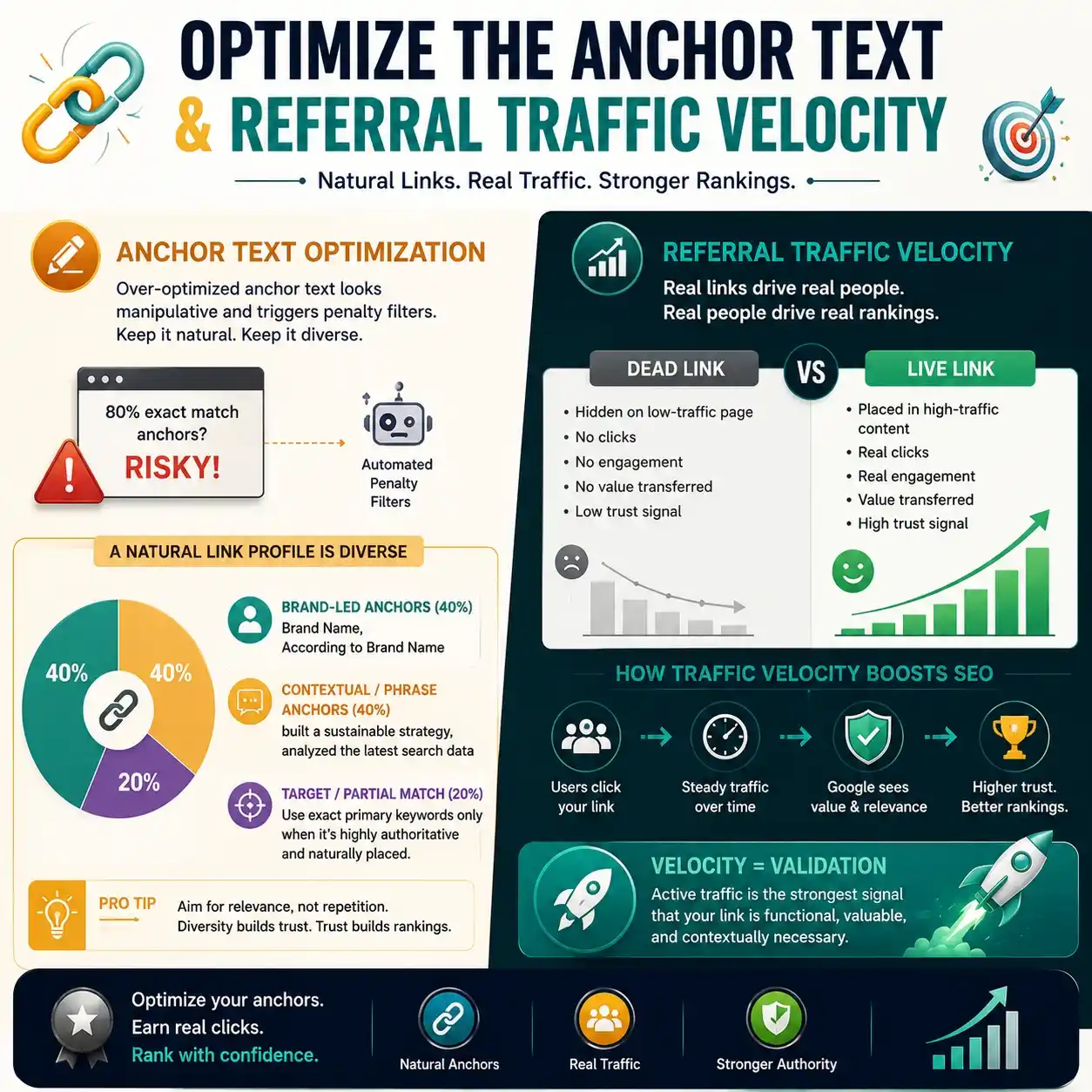
Many SEO campaigns collapse because their link profiles look engineered. If 80% of your incoming links use your exact target keyword as the clickable text, you are triggering automated penalty filters.
Anchor Text Optimization
Natural link profiles are inherently messy. To execute clean anchor text optimization, your link profile must display a diverse mix of anchor types:
- Brand-Led Anchors: Brand Name, According to Brand Name
- Contextual/Phrase Anchors: built a sustainable strategy, analyzed the latest search data
- Target/Partial Match: Only use exact primary keywords when the placement is highly authoritative and occurs completely naturally within premium editorial content.
Referral Traffic Velocity
Google easily distinguishes between a dead link on an unread site and an active link on a live publication. Real editorial links drive real human behavior.
Engagement factors now contribute significantly to the efforts made by companies to achieve sustainable rankings positions amid stiff competition in the search results.
When a link is placed contextually within a high-traffic article, it generates referral traffic velocity, a steady stream of real users clicking through to your site. This active traffic pattern tells Google’s algorithm that the link is functional, valuable, and contextually necessary, significantly boosting the trust score transferred to your domain.
Reclaim Value via Broken Link Reclamation
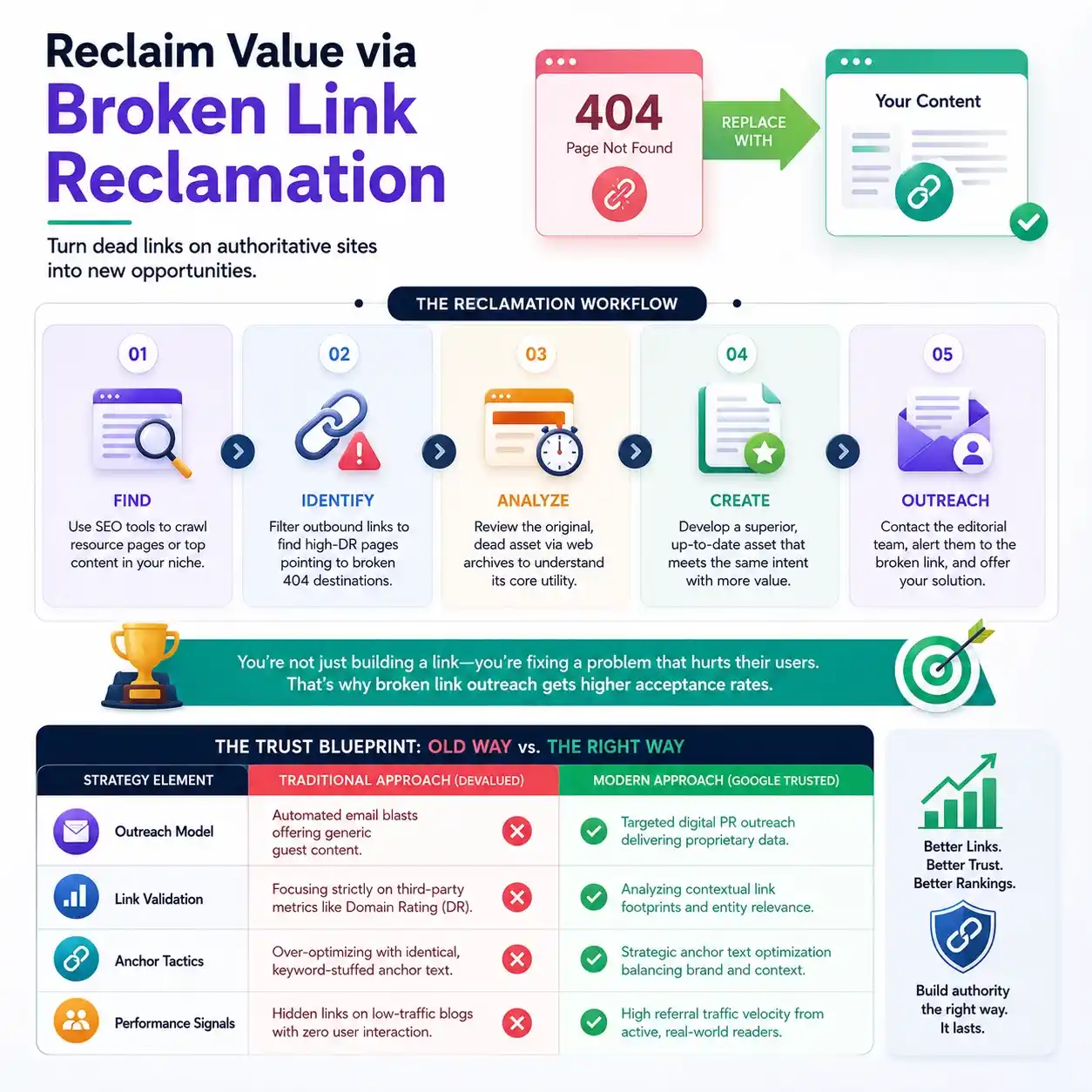
While digital PR drives massive authority spikes, you can supplement your campaign with highly targeted tactical execution. The most efficient framework for this is broken link reclamation.
Thousands of high-value resource pages, industry guides, and media articles currently point to dead 404 pages because domains expired or content was deleted. By finding these broken links on contextually relevant, authoritative domains, you can pitch your active, high-quality asset as the perfect, immediate replacement.
The Reclamation Workflow
- Use specialized SEO tools to crawl resource pages or top content in your specific industry niche.
- Filter the outbound links to identify high-DR pages pointing directly to broken 404 destinations.
- Review the original, dead asset via web archives to understand its core utility.
- Develop a vastly superior piece of content on your own domain that satisfies the exact same user intent while introducing updated data.
- Reach out directly to the editorial team managing the site, alert them to the broken link dragging down their user experience, and offer your active asset as the drop-in solution.
Because you are actively resolving a technical error that harms their on-site user flow, editorial acceptance rates for broken link outreach remain significantly higher than cold, manipulative pitches.
Go Through This Trust Blueprint
Building links that Google trusts requires abandoning shortcuts. By aligning your off-site footprint with editorial integrity, strict contextual relevance, and genuine user value, you build a sustainable foundation that converts search engine trust into permanent organic visibility.
| Strategy Element | Traditional Approach (Devalued) | Modern Approach (Google Trusted) |
| Outreach Model | Automated email blasts offering generic guest content. | Targeted digital PR outreach delivering proprietary data. |
| Link Validation | Focusing strictly on third-party metrics like Domain Rating (DR). | Analyzing contextual link footprints and entity relevance. |
| Anchor Tactics | Over-optimizing with identical, keyword-stuffed anchor text. | Strategic anchor text optimization balancing brand and context. |
| Performance Signals | Hidden links on low-traffic blogs with zero user interaction. | High referral traffic velocity from active, real-world readers. |
Backlinking is not a standalone strategy anymore; rather, backlinks are pieces of a larger puzzle of search visibility. Get to know how all these SEO factors relate to each other by checking out our guide, SEO Complete Guide for Businesses in the USA (2026).
Need an SEO Expert? Ever Heard About SocialzRank?
Stop wasting time on vanity SEO agencies that measure success in “impressions” while your pipeline dries up. At SocialzRank, we build search engine optimization strategies for one metric: revenue. In a search marketplace, where Google AI Overviews devour over 60% of traditional informational clicks, standard keyword stuffing is dead. We construct high-converting conversion funnels, dominate Answer Engine Optimization (AEO), and intercept your high-value buyers at the exact moment they are ready to convert.
Frequently Ask Questions
Cheap agencies buy low-tier links from spam networks that trigger automated penalties. We secure authoritative editorial placements and high brand mention attribution that drive real organic pipeline revenue.
Expect 60 to 90 days for modern search crawlers to index new entity connections. Sustainable, repeatable organic revenue growth typically scales between months 4 and 6 of a dedicated campaign.
Yes, but the goal has changed. Brands with authoritative editorial links correlate 3x more strongly with AI visibility because answer engines use those trusted entities as their core sourcing citations.
No. Raw AI content is generic and lacks the unique information gain metrics editors demand. We conduct first-party surveys and analyze industry benchmarks to create data assets editors actually want to reference.
We ignore vanity traffic metrics. SocialzRank tracks metrics that impact your balance sheet: organic conversion rates, referral traffic velocity, qualified pipeline leads, and direct search-attributed revenue.
Most campaigns fail because they build irrelevant links with over-optimized text strings. We focus on building contextual link footprints and entity relevance that directly match the search intent of your target buyers.
We need 3 to 5 hours during the onboarding month for discovery interviews and asset audits. After that, we handle the heavy lifting, requiring only 2 hours per month for strategy reviews and approvals.
You own everything we secure. Every editorial link, digital PR placement, data asset, and custom cluster blueprint remains 100% yours. We keep clients through measurable financial ROI, not legal traps.