
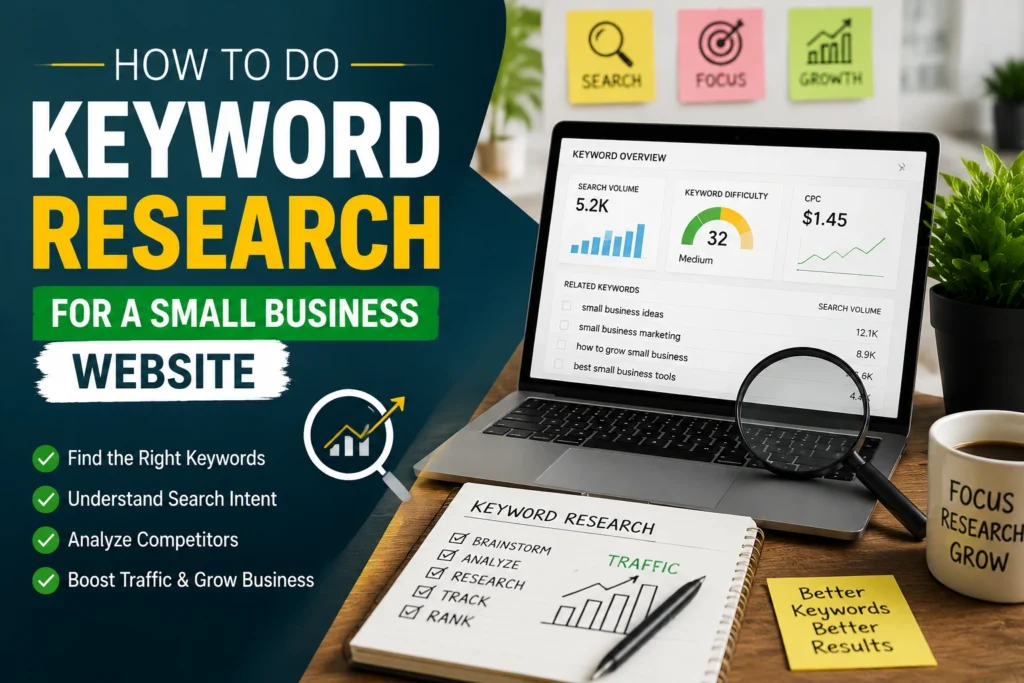

Independent brands routinely waste their marketing budgets writing website articles for massive, generalized search terms that they have zero chance of ranking for on search engines. When localized companies compete head-to-head against national enterprise corporations for broad industry phrases, they are essentially flushing their resource capital away.
Learning how to properly execute keyword research small business frameworks allows you to bypass these unwinnable authority battles and target hyper-specific user groups instead. For businesses who wish to learn about how keyword research fits into a broader SEO plan, check out our Complete Guide to SEO for Businesses in the USA (2026). By shifting your attention away from raw search volume and focusing completely on user intent, you can transform your digital footprint into a highly targeted sales pipeline.
Five Quick Steps for Rapid Audience Identification

1. Extracting Existing Operational Data
Before purchasing expensive third-party data tracking suites, you must audit the hidden search signals your website is already generating. Utilizing direct Search Console extraction allows you to review the exact phrases consumers type to find your current landing pages.
This diagnostic review uncovers hidden terms where your site might be sitting on page two or three of the search results, giving you an immediate list of optimization targets that require minimal layout adjustment to rank higher.
2. Hunting Down Accessible Competition Gaps
Digital marketing analysis indicates that targeting these specific competitor gap insights allows niche service providers to capture up to 35% more qualified local leads than general marketing campaigns.
To scale a modest digital footprint, you need to identify where larger industry players have left content gaps. As you run a thorough audit, you uncover competitor gap insights. This reveals long-tail variations and niche topics that corporate entities often overlook because the search volumes are too small. Many developing companies utilise expert SEO services for small businesses to find these opportunities and transform them into qualified local traffic.
3. Layering Commercial Purchase Intent Modifiers
Raw traffic figures mean absolutely nothing if the consumers clicking your links have zero intention of buying your services. You must filter your seed lists by adding highly specific commercial intent modifiers like price, corporate packages, installation cost, or top-rated providers.
Applying these commercial intent modifiers instantly separates casual web researchers looking for free tutorials from motivated buyers holding credit cards who are ready to book an appointment immediately.
4. Securing Low-Difficulty Entry Points
Your optimization roadmap must prioritize high-intent phrases that match your current domain authority level. Filtering your tracking sheets for low difficulty opportunities guides you spend your time building pages for terms you can realistically rank for within a few weeks.
Targeting these low difficulty opportunities gives your website the initial momentum it needs to build domain strength without wasting months waiting for highly competitive metrics to shift.
5. Implementing Geographic Specificity Elements
For a neighborhood brick-and-mortar operation or a regional service provider, broad national traffic is completely useless. You must weave hyperlocal search terms like specific cross-streets, neighborhood quadrants, or landmark identifiers directly into your structural keyword targets.
By focusing on hyperlocal search terms, your business appears in local map packs. As a result, you also show up in mobile search queries when nearby users are actively looking for your services.
Five Expert Steps for Advanced Search Dominance
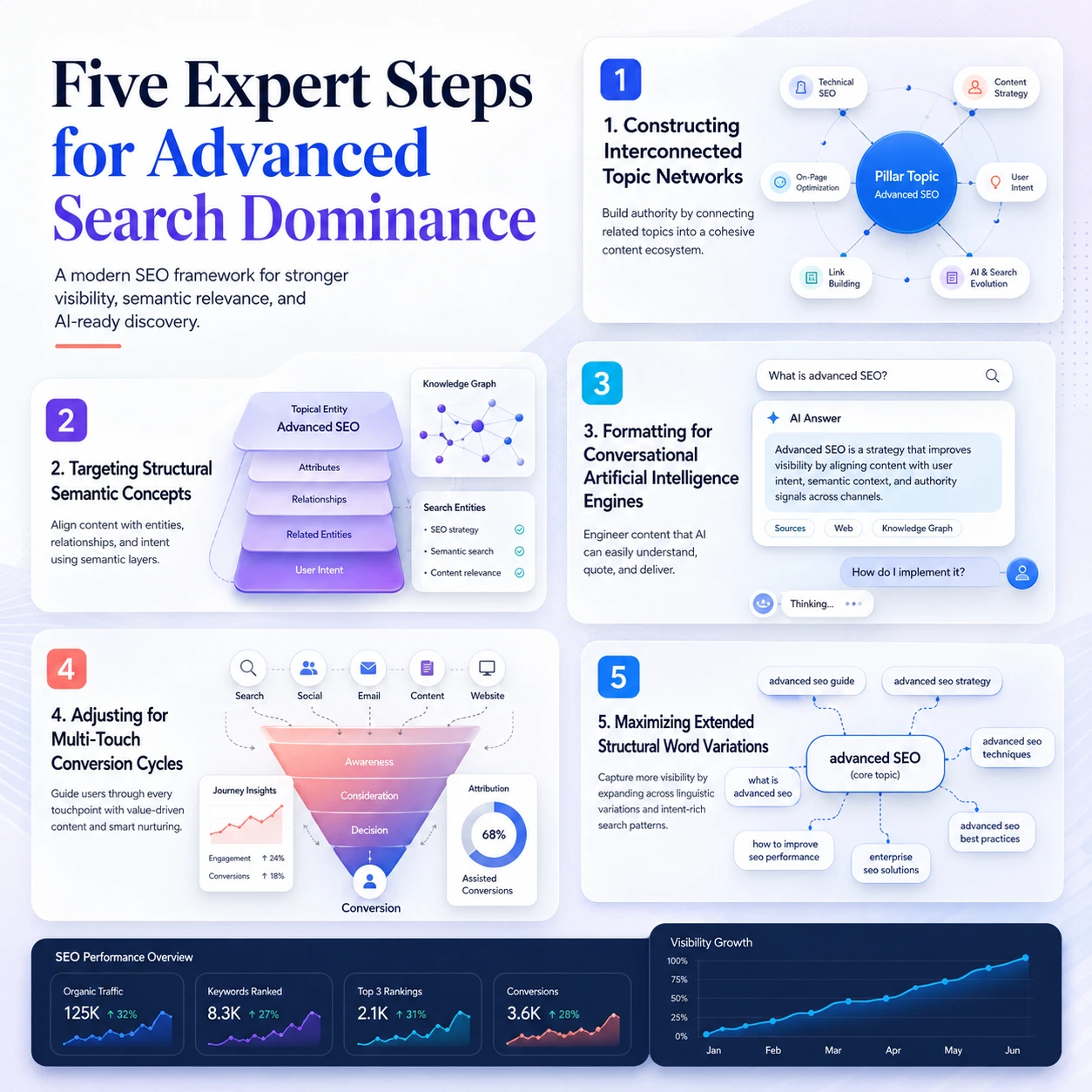
1. Constructing Interconnected Topic Networks
Modern search algorithms no longer evaluate websites based on isolated phrase matches; they rank domains based on complete topical authority. Developing an advanced topical cluster mapping framework involves building a core pillar resource and supporting it with tightly focused sub-pages that address every angle of a specific subject.
This structured topical cluster mapping strategy proves to search engines that your small business possesses deep, comprehensive expertise across your entire industry niche.
2. Targeting Structural Semantic Concepts
Search engines now use knowledge graphs to understand user queries. This makes traditional keyword stuffing less effective.
Transitioning to entity based targeting means incorporating specific real-world concepts, industry tools, and structural relationships into your paragraphs. Embracing entity based targeting helps search networks categorize your content accurately, ensuring your landing pages match the exact semantic concepts your customers expect to see.
3. Formatting for Conversational Artificial Intelligence Engines
Consumer search habits are shifting away from short text queries toward complete conversational statements powered by generative AI assistants. Optimizing for this shift requires precise AEO citation formatting. This means structuring content with clear questions followed by short, data-backed answers.
Using clean AEO citation formatting improves your chances of being recognized and cited as a trusted source in AI-generated summaries.
4. Adjusting for Multi-Touch Conversion Cycles
Conversion tracking telemetry shows that analyzing these conversion lag metrics allows companies to optimize their follow-up email campaigns, reducing overall sales cycle length by nearly 20%.
High-value business purchases rarely occur during an initial web visit, which makes tracking user journey delays essential for accurate reporting. Evaluating your internal conversion lag metrics shows how long it takes a user to move from an informational search to a final purchase.
5. Maximizing Extended Structural Word Variations
The final stage of advanced search optimization requires looking past short phrases and building assets for descriptive, multi-word consumer queries. Expanding your list to include specific long tail variations allows you to capture buyers who are further along in their decision-making process.
Because these long-tail variations have low competition and high user intent, they represent high-converting opportunities for growing your online presence.
No More Chasing Traffic and Start Engineering Local Revenue
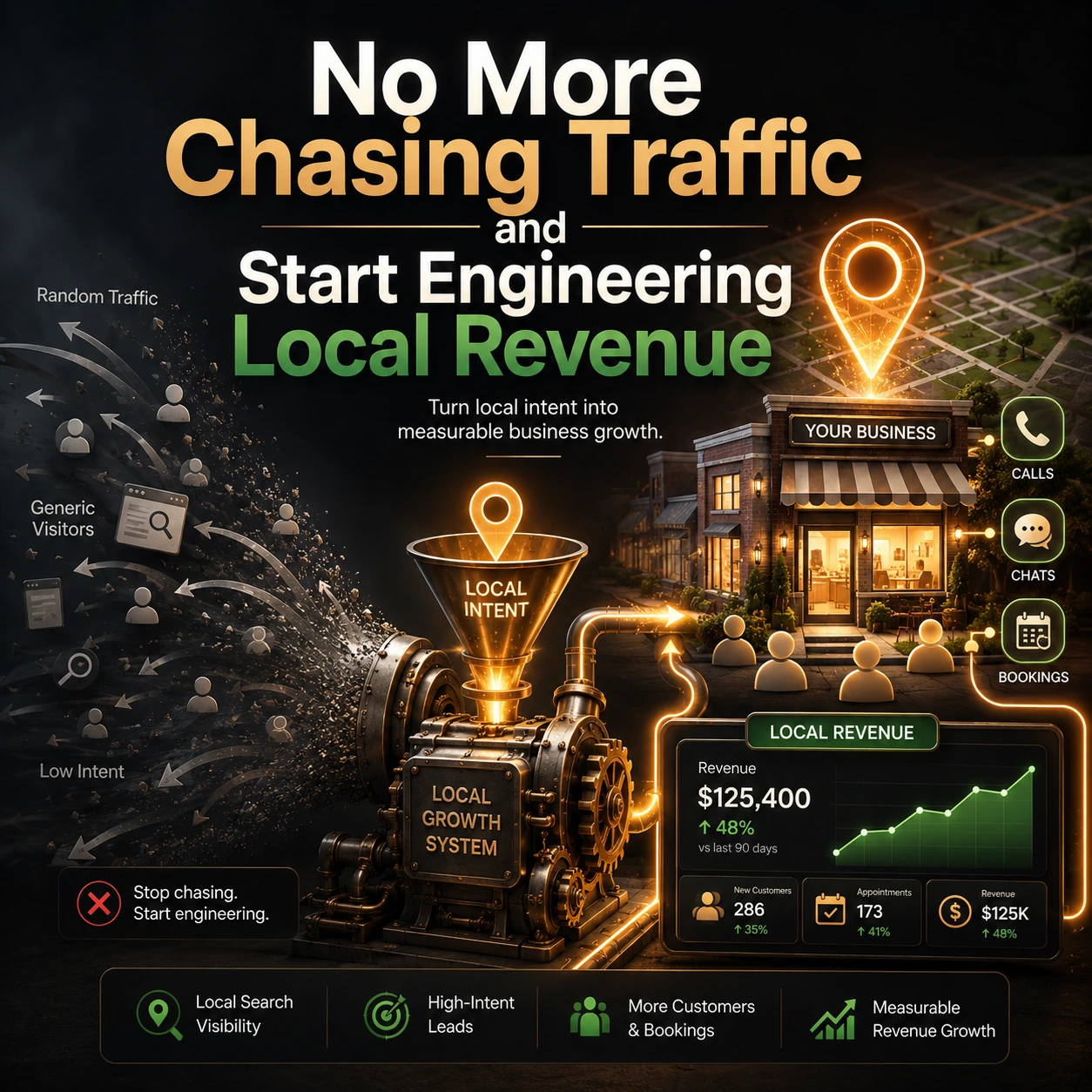
Relying on broad search metrics is a direct path to an invisible digital footprint. If your team focuses on general industry terms instead of local zip codes, then you may be limiting your growth. As a result, this blocks access to high-intent local opportunities and ultimately slows down your results.
Executing a calculated keyword research small business strategy highlights your digital channels operate with absolute precision. Invest your resources to reach high-intent local buyers. Improve visibility on modern AI discovery platforms. Focus on opportunities your competitors are missing. This helps you achieve stronger growth and better results. Building a search pipeline on verified local user data turns your website into a predictable, automated customer acquisition system. Check out our USA SEO strategy guide for 2026 for a full discussion of keyword research, technical SEO, content optimisation, local SEO, and authority building.
SocialzRank is the tactical optimization powerhouse built to scale small business digital footprints across competitive local markets. We skip abstract creative theories and vanity traffic metrics to deliver data-driven optimization strategies that impact your bottom line. Our team audits your online presence to find hidden conversion opportunities. We then run focused search campaigns to attract motivated buyers.
Frequently Ask Questions
Focusing on a dedicated keyword research small business blueprint allows smaller brands to target niche, high-intent local phrases, helping them outrank massive national competitors who only focus on broad terms.
They filter out low-value informational traffic, ensuring your ad spend and content hours are spent entirely on buyers who are actively looking to purchase.
These multi-word phrases have significantly lower competition and much higher conversion rates, giving new websites a faster path to page one rankings.
It highlights specific phrases where your site already ranks on page two, allowing you to quickly update that content and push it into high-visibility positions.
They show you the exact high-value topics and customer questions your competitors forgot to cover, leaving the market wide open for your business.
Mobile users look for immediate, nearby solutions; targeting neighborhoods and local landmarks means you appear right when they search on the go.
Yes, focusing on clear conceptual entities helps search algorithms understand the true context of your business, making it easier for AI engines to recommend you.
Structuring your information clearly using question-and-answer patterns confirms your site gets picked up as a primary source inside AI-generated answer summaries.