
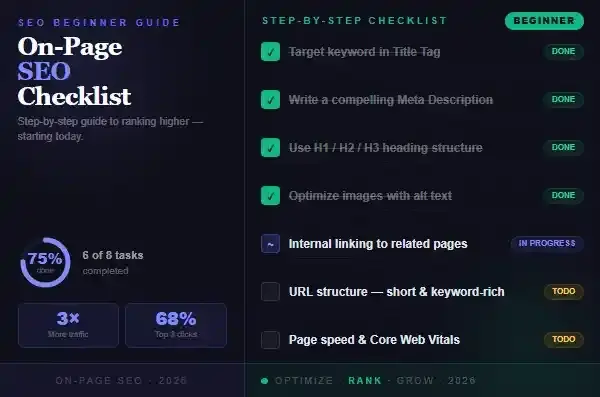

Table of Content
- Introduction
- Let’s Decode the Checklist: How Modern Engines Read a Page
- Step 1: Content Architecture and Intent-Based Headers
- Step 2: Optimizing for the AI Ecosystem (AEO & SGE)
- Step 3: Technical On-Page Excellence & Core Web Vitals
- SocialzRank: Stop Collecting To-Do Lists. Start Collecting Profits.
Introduction
On-page SEO is the practice of optimizing elements directly within a website page, such as HTML tags, content structure, image data, and internal links, to earn higher search engine rankings and attract more relevant organic traffic.
Implementing a comprehensive on-page SEO checklist is the process of optimizing individual web pages so that search engines and AI models can immediately decode their structural meaning, context, and intent. Today, in 2026, page-level optimization has evolved far beyond just repetitive keyword placement. It is a systematic architectural framework designed to align human readability with machine intelligence, an approach discussed throughout this complete SEO guide for businesses in the USA. If your pages lack specific semantic parameters and clear performance signals, algorithms will simply ignore your content, regardless of its quality.
Let’s Decode the Checklist: How Modern Engines Read a Page
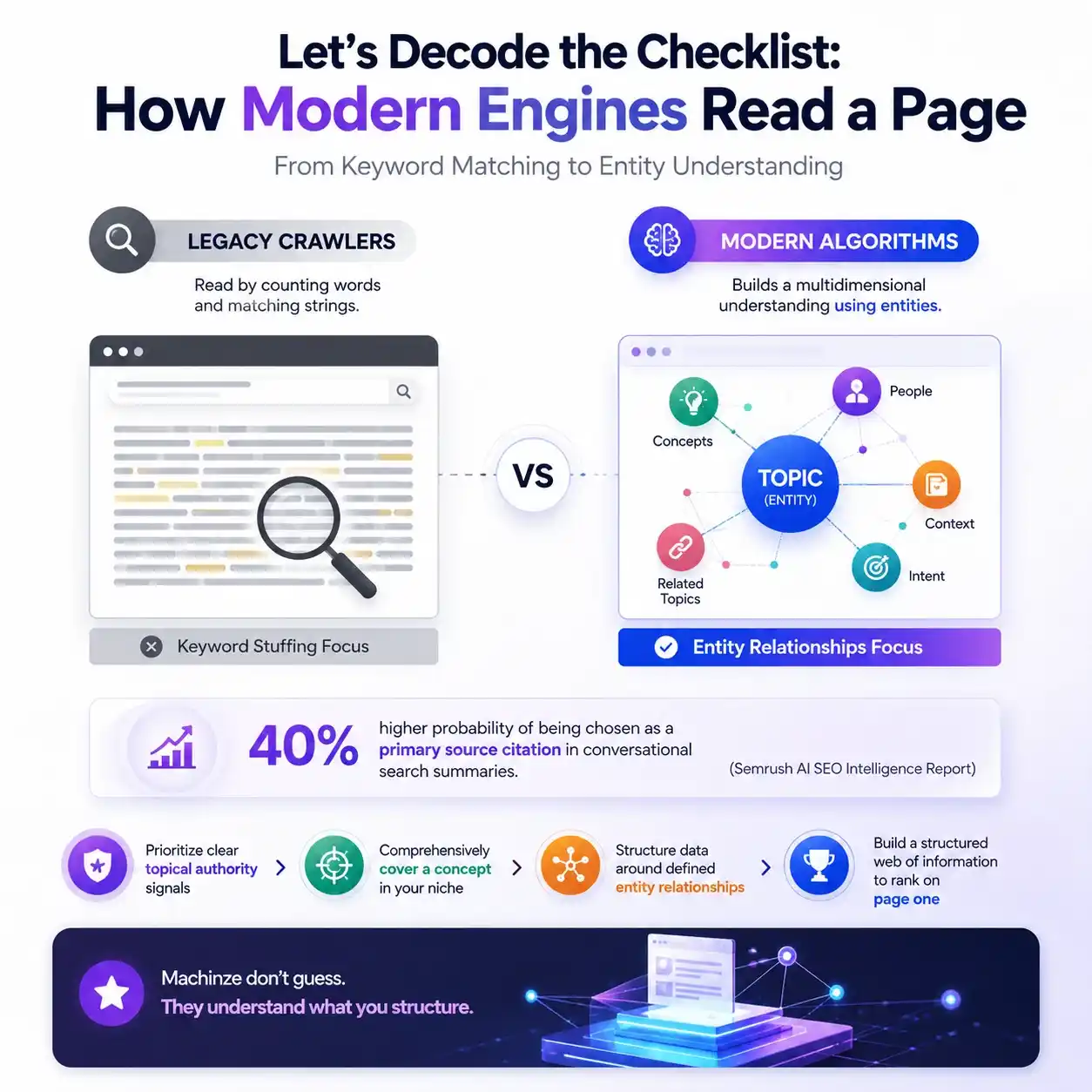
The mechanics of how search engines evaluate web content have changed. Legacy crawlers used to read a page simply by counting phrase repetitions and matching strings of characters. Modern search algorithms, however, rely on entity-based indexing to build a multidimensional understanding of your content.
As a result, this shift means your page must prioritize clear topical authority signals. Google evaluates how comprehensively a single URL addresses a concept within an industry ecosystem.
The recent Semrush AI SEO Intelligence Report suggests that websites that explicitly structure their data around clearly defined entity relationships see a 40% higher probability of being chosen as a primary source citation in conversational search summaries compared to sites using legacy keyword-stuffing methods. Therefore, to rank on page one today, your content must be built as a structured web of information that machines can easily categorize.
Step 1: Content Architecture and Intent-Based Headers
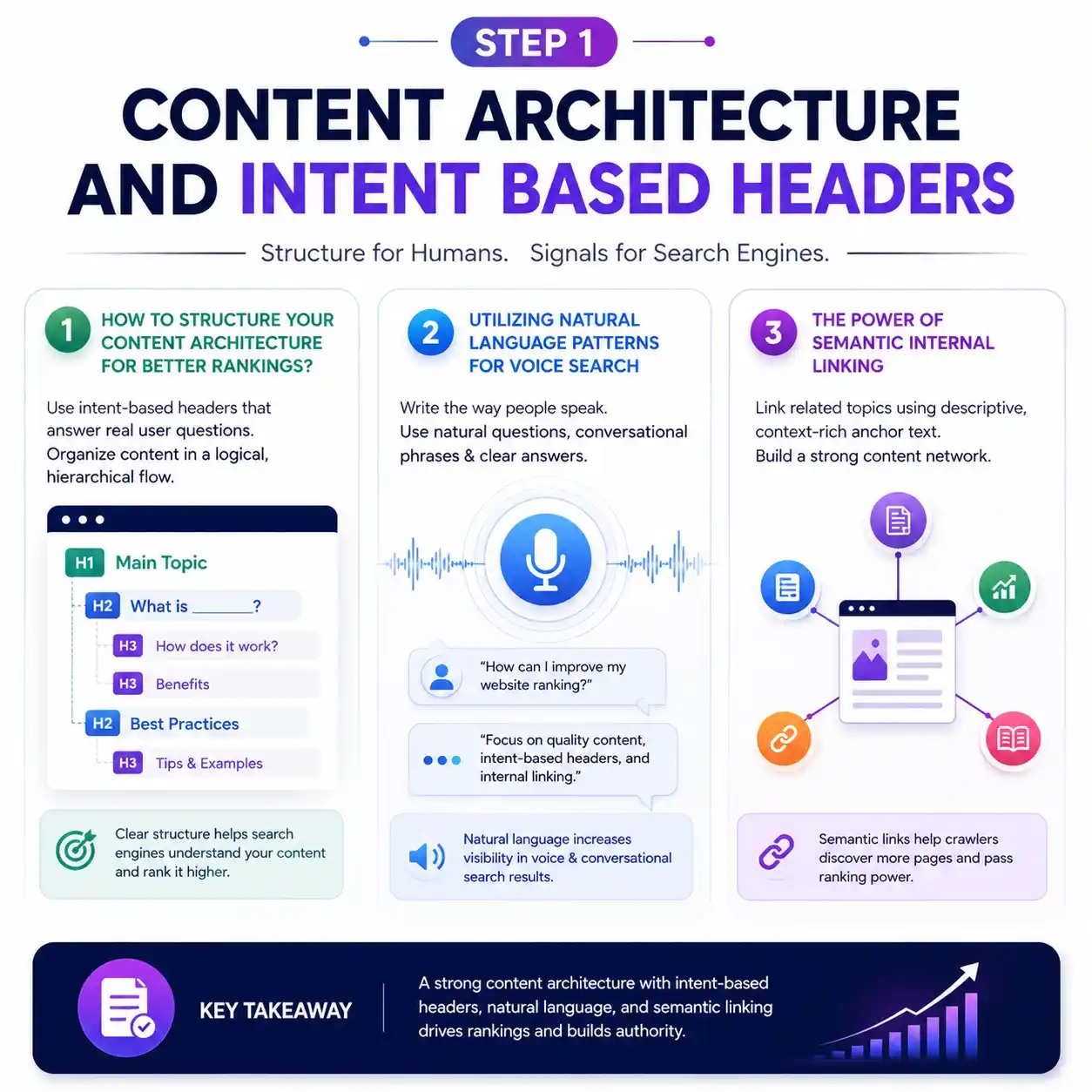
The structural spine of any high-ranking page relies heavily on how its content sections are divided. Unfortunately, beginners frequently treat headings as mere styling tools to adjust font sizes. To capture modern visibility, headings must be treated as specific structural signposts.
How to Structure Your Content Architecture for Better Rankings?
To pass the strict criteria of an on-page SEO checklist, you must build intent-based headers using specific heading tags (H2, H3, H4) formatted as direct user questions. Instead of using a generic, vague heading like “SEO Tools,” your heading must explicitly state what the user is seeking, such as “Which Free Optimization Tools Work Best?” Consequently, this clear formatting immediately tells the crawler exactly what problem the subsequent paragraph solves.
Utilizing Natural Language Patterns for Voice Search
Your headers and introductory paragraphs must align perfectly with natural language patterns. Additionally, when users seek answers through voice assistants or generative search tools, they speak in complete, conversational sentences rather than fragmented search phrases. Writing texts based on natural language structure makes it easier for software to search for and comprehend your content..
The Power of Semantic Internal Linking
In fact, an isolated page is a vulnerable page. You must implement a strict semantic internal linking framework that connects your new content to existing high-value pillar articles. By using descriptive, context-rich anchor text to link between related topics, you guide search crawlers through your domain’s content clusters. This internal network distributes ranking power evenly across your site and proves to the algorithm that your domain contains a deep, interconnected pool of knowledge.
Step 2: Optimizing for the AI Ecosystem (AEO & SGE)
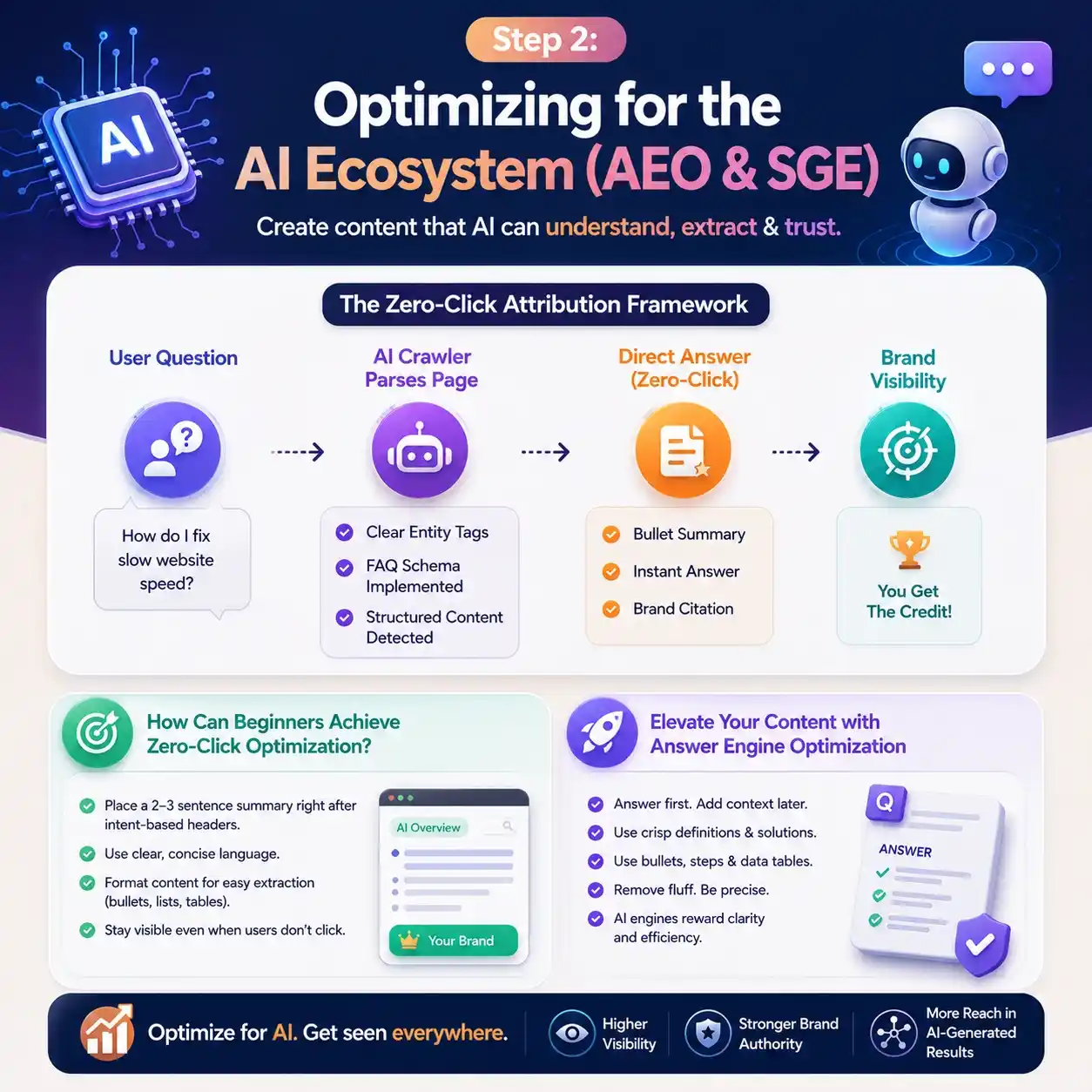
As search behaviors transition toward conversational models, optimizing exclusively for human web browsers is no longer sufficient. Your page should have a well-defined structure to allow AI systems to understand your content within the larger context of artificial intelligence.
The Zero-Click Attribution Framework
| User Question | AI Crawler Parses Page | Direct Answer |
| How do I fix… | Clear Entity Tags – FAQ Schema Implemented | Bullet Summary – Brand Citation |
How Can Beginners Achieve Zero-Click Optimization on Modern SERPs?
To achieve consistent zero click optimization, your formatting must allow search bots to instantly extract information. When an AI overview synthesizes an answer for a user, it scans the web for clean data blocks, a critical part of modern SEO strategies for businesses in the USA.
For example, by inserting a highly concise, 2-to-3 sentence summary immediately following an intent-based header, you create an ideal target for machine extraction. The particular tactic allows you to keep your brand at the forefront as the trusted provider of information even when users don’t visit your website.
Elevate Your Content with Answer Engine Optimization
Executing answer engine optimization requires the total elimination of conversational fluff. No long, winding introductory sentences are allowed. Your content must state the problem, deliver the exact definition or solution immediately, and back that solution up with clear, structured bullet points or data tables. AI-powered search engines consider efficiency their topmost priority and tend to filter out webpages containing answers buried in extensive creative content generated by search citations.
Step 3: Technical On-Page Excellence & Core Web Vitals
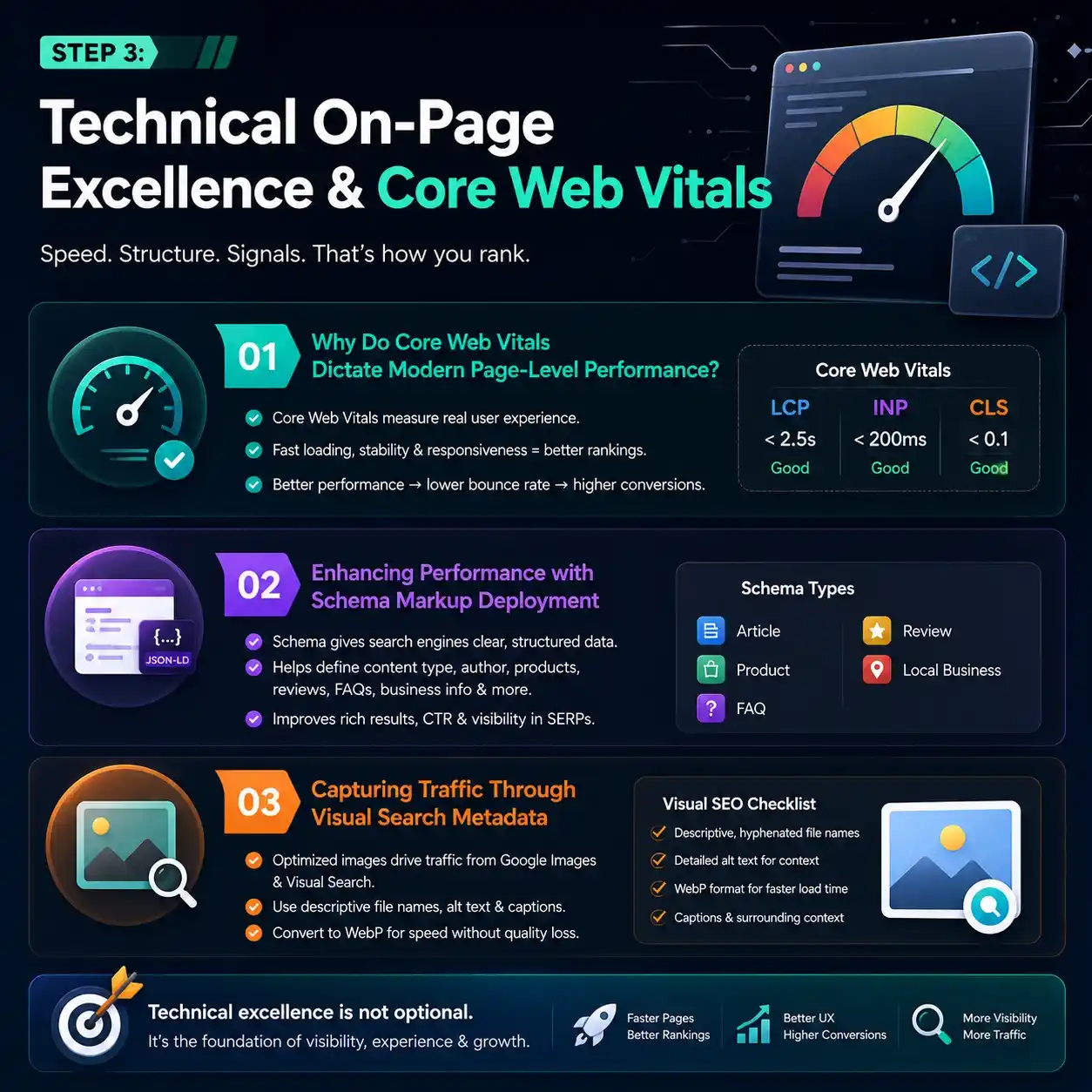
A beautifully structured article is completely useless if the underlying technical performance of the page frustrates users and search bots alike. Your technical on-page elements must be fast, stable, and highly descriptive.
Why Do Core Web Vitals Dictate Modern Page-Level Performance?
Your technical architecture must satisfy Google’s strict core web vitals thresholds, which evaluate real-user loading speeds, visual stability, and interaction responsiveness. Specifically, metrics like Interaction to Next Paint (INP) demand that your page to respond to a user’s click or tap within 200 milliseconds. Websites that successfully optimize their technical infrastructure to pass all Core Web Vitals benchmarks experience an average 10% to 25% increase in conversion rates alongside a sharp reduction in mobile bounce metrics.
Enhancing Performance with Schema Markup Deployment
Moreover, to confirm your technical metrics translate directly into search visibility, you must prioritize precise schema markup deployment. Using JSON-LD structured data in your HTML markup helps the search engine better understand your content. This structured data could describe what kind of article you have written, who wrote it, what product you offer, or where your business is located. This code eliminates guesswork for the crawler, making your site much easier to index accurately.
Capturing Traffic Through Visual Search Metadata
The modern user journey is increasingly visual. To unlock hidden traffic sources, your images and video assets must be paired with comprehensive visual search metadata. This means every image needs a descriptive, hyphenated file name and WebP conversion for better speed. Furthermore, it also requires detailed alt text that explains the image clearly to users and search crawlers.
For a broader breakdown of modern ranking systems, explore our complete business SEO framework for 2026.
SocialzRank: Stop Collecting To-Do Lists. Start Collecting Profits.
Staring at a massive on-page SEO checklist can feel completely overwhelming for a growing business. Identifying semantic gaps, configuring complex JSON-LD data code, and re-engineering your site’s visual assets requires specialized precision. At SocialzRank, We simplify the technical complexity and create an effective system that guarantees stable revenue growth. Learn more about our SEO Services and discover how we create comprehensive SEO ecosystems.
Additionally, our technical teams will conduct an audit of your architecture and implement entity mapping for increased effectiveness in your SEO strategy. Guess what? We don’t just help you rank; we ensure your web infrastructure converts casual search traffic into loyal clients.
Frequently Ask Questions
An on-page SEO checklist focuses entirely on elements you can directly control within your own website code and content architecture, such as headers, metadata, speed, and internal linking. Off-page strategies focus on building external trust signals, such as earning backlinks from other authoritative domains.
It is an advanced classification method where search platforms view the web as a collection of interconnected concepts and real-world objects rather than isolated words. By understanding the relationships between these entities, search engines can provide far more accurate and contextual results to users.
By writing headings as direct questions that mirror actual user problems, you make your content exceptionally easy to skim. Users can quickly scroll down the page, find the exact sub-section that addresses their current issue, and read the solution without wasting time on unrelated text.
Because Google prioritizes user satisfaction. If a page loads slowly, shifts positions while loading, or takes too long to respond to clicks, users will immediately abandon the site. Excellent scores prove to the algorithm that your website offers a stable, efficient user experience.
It makes sure your business wins visibility inside AI overview boxes and featured snippets on the results page. Even if a user gets their answer without visiting your site, your brand name is displayed as the trusted source, which builds massive market awareness and trust.
It acts as an explicit data translation layer. By providing code that labels your content cleanly (e.g., explicitly defining a block of text as an "FAQ" or a "Product Review"), you remove all ambiguity, allowing search crawlers to index your site with complete accuracy.
Because voice search and conversational AI models are standard. People do not search using rigid text strings anymore; they ask complete questions. Content written using natural, conversational phrases matches these modern queries perfectly.
It confirms your visual assets can rank within Google Images and visual search engines. By providing descriptive alt-text and clean file names, you help search engines understand the context of your media, which opens up an entirely separate stream of organic traffic.