

Table of Content
- Introduction
- The Technical Fixes
- Crawl Budget Leakage & Parameter Governance
- Core Web Vitals Stability Limits
- The 2MB Document Fetch Rule
- Hire SocialzRank for Expert Technical SEO
Introduction
Optimizing your site architecture using a definitive technical SEO guide requires systematically identifying and resolving infrastructure bottlenecks. Prioritize plugging crawl budget leaks and executing clean canonicalization error fixes to make sure modern search engine bots index your highest-converting landing pages.
Get more detailed information about how rankings work, technical optimization, and advanced techniques used in searches by checking out “The Complete Guide to SEO for Businesses in the USA (2026)”.
As Google’s primary responsiveness metric, INP isolates total page responsiveness by measuring the latency of all user interactions (clicks, taps, keyboard inputs) across the entire session lifecycle, rather than just the initial input. Moreover, when INP spikes above the 200ms threshold, it’s almost always a main-thread execution bottleneck caused by long-running JavaScript event handlers.
| User Action | Event Type | Cause/Reason |
| Click/Tap | Long-running Event Handlers | High CPU utilization |
| Click/Tap | Input Delay | Script evaluation blocks the main thread |
| Click/Tap | Processing | Heavy DOM manipulation or layout thrashing |
| Click/Tap | Processing | Synchronous third-party tag firing |
| Click/Tap | Presentation | Browser rendering engine waits for frame paint |
| Click/Tap | Presentation | [INP Score Blowout > 200ms] |
The Technical Fixes
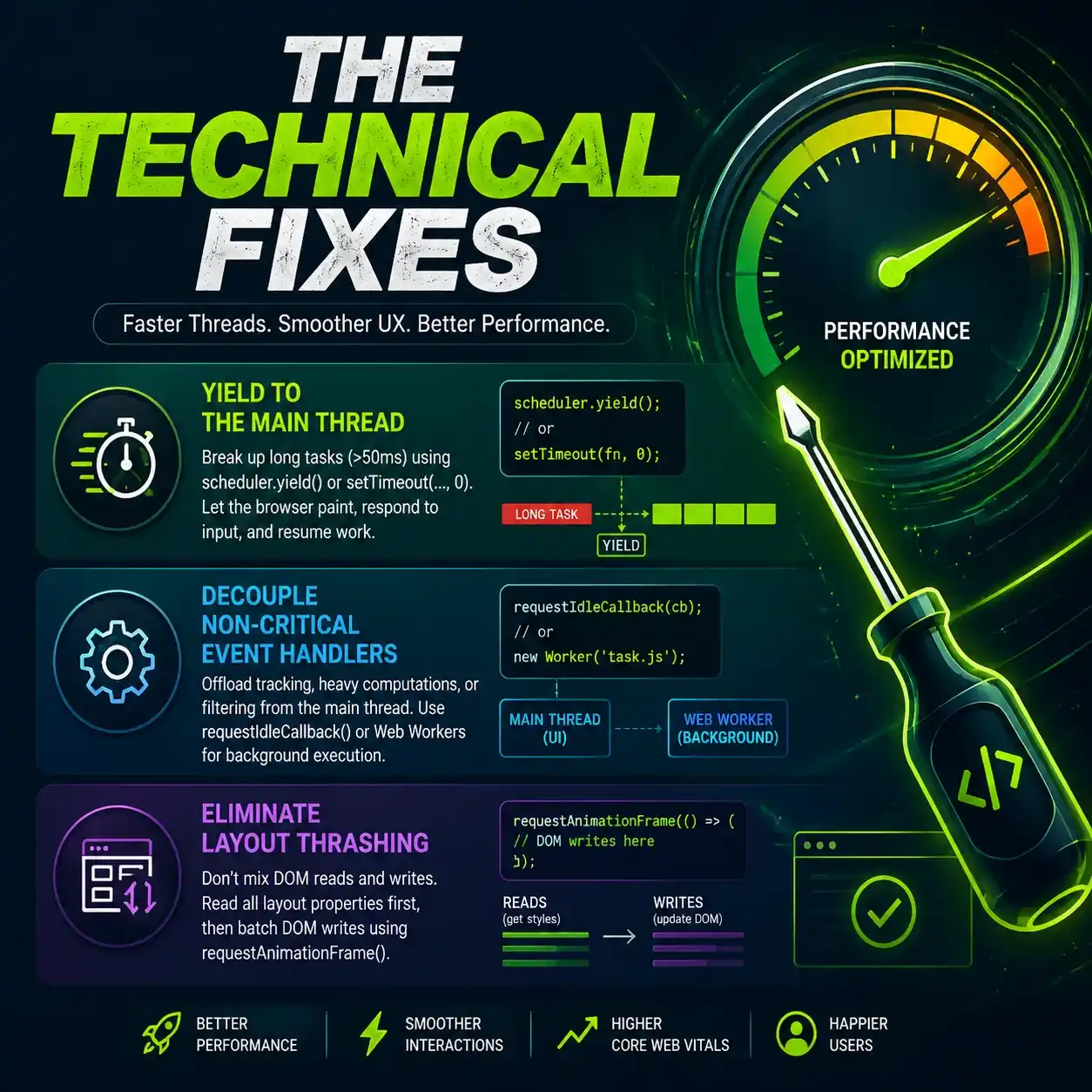
- Yielding to the Main Thread: Break up long tasks (anything exceeding 50ms) using scheduler.yield() or asynchronous setTimeout(…, 0) wrappers. This forces the browser to pause heavy script execution, paint the next frame immediately responding to the user’s input, and resume background processing afterward.
- Decouple Non-Critical Event Handlers: Offload data tracking, complex state computations, or client-side filtering out of the primary execution loop. Utilize requestIdleCallback() for non-essential executions or delegate heavy algorithmic sorting entirely to background Web Workers.
- Eliminate Layout Thrashing: Ensure event handlers don’t write to the DOM and immediately read style properties sequentially within the same execution frame. Group all DOM reads together first, then execute DOM writes via requestAnimationFrame().
Crawl Budget Leakage & Parameter Governance
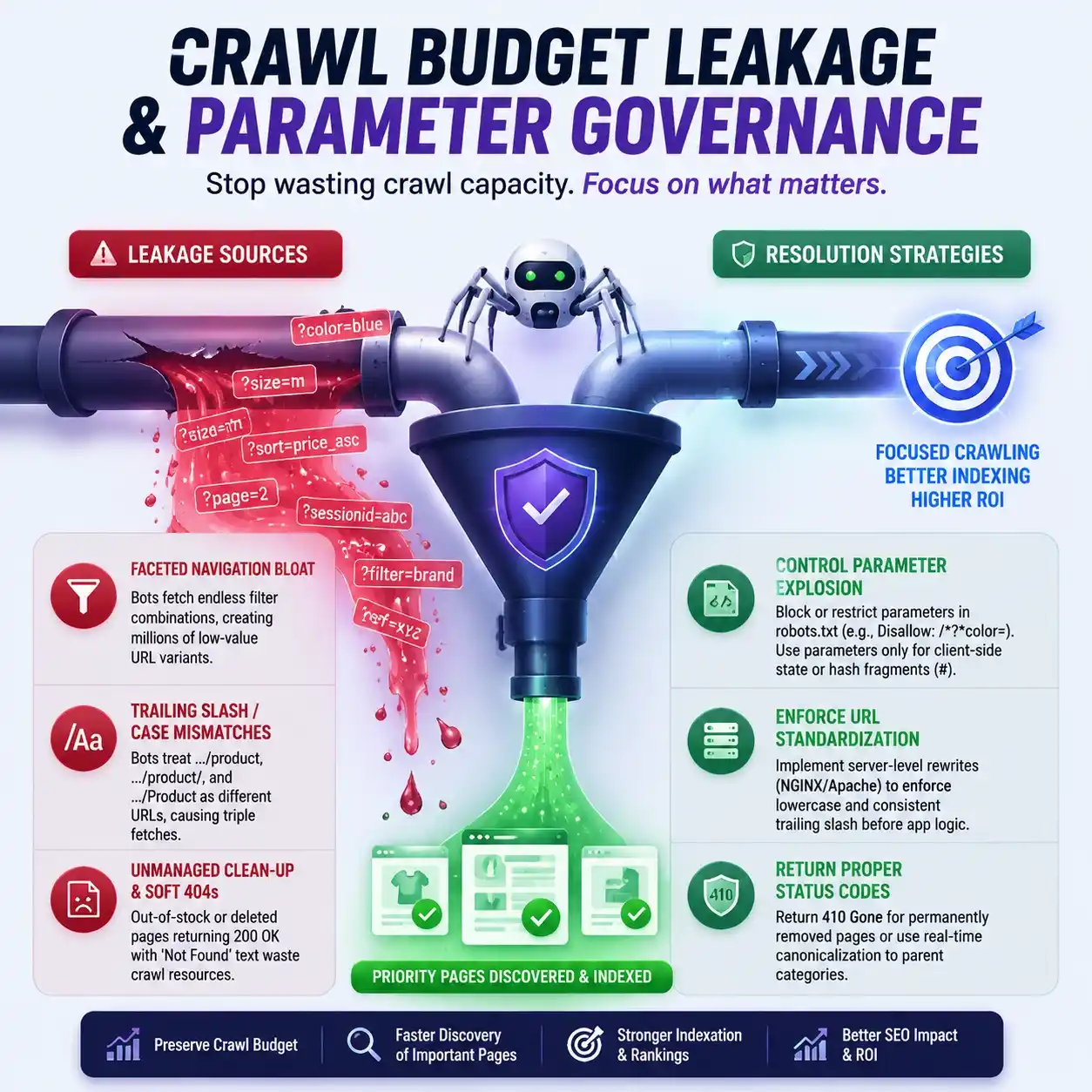
At scale (100k+ URLs or massive faceted architectures), index dilution and discovery lag occur because search engine bots get trapped in infinite parameter permutations, duplicate sorting configurations, and session identifier loops. This exhausts your crawl capacity limit before bots ever discover high-margin or newly updated priority pages.
| Leakage Source | Bot Mechanism / Pattern | Technical Resolution Strategy |
| Faceted Navigation Bloat | Bots sequentially fetch combinations of filters (?color=blue&size=m&sort=price_asc), generating millions of low-value URL variants. | Enforce structural directory handling or drop a Disallow: /*?*color= rule inside the robots.txt. Reserve parameter generation exclusively for client-side state transitions or hash fragments (#) that bots ignore. |
| Trailing Slash / Case Mismatches | Bots treat …/product, …/product/, and …/Product as distinct entities, executing triple fetches for a single asset. | Enforce server-level rewriting rules (NGINX/Apache) to standardize lowercase execution and trailing slash uniformity before processing application logic. |
| Unmanaged Clean-up & Soft 404s | Out-of-stock or deleted pages returning a 200 OK with ‘Not Found’ text force search crawlers to consistently evaluate dead space. | Standardize explicit server responses: return clean 410 Gone headers for permanently retired assets to purge them from crawl loops, or implement real-time canonicalization to parent categories. |
Core Web Vitals Stability Limits
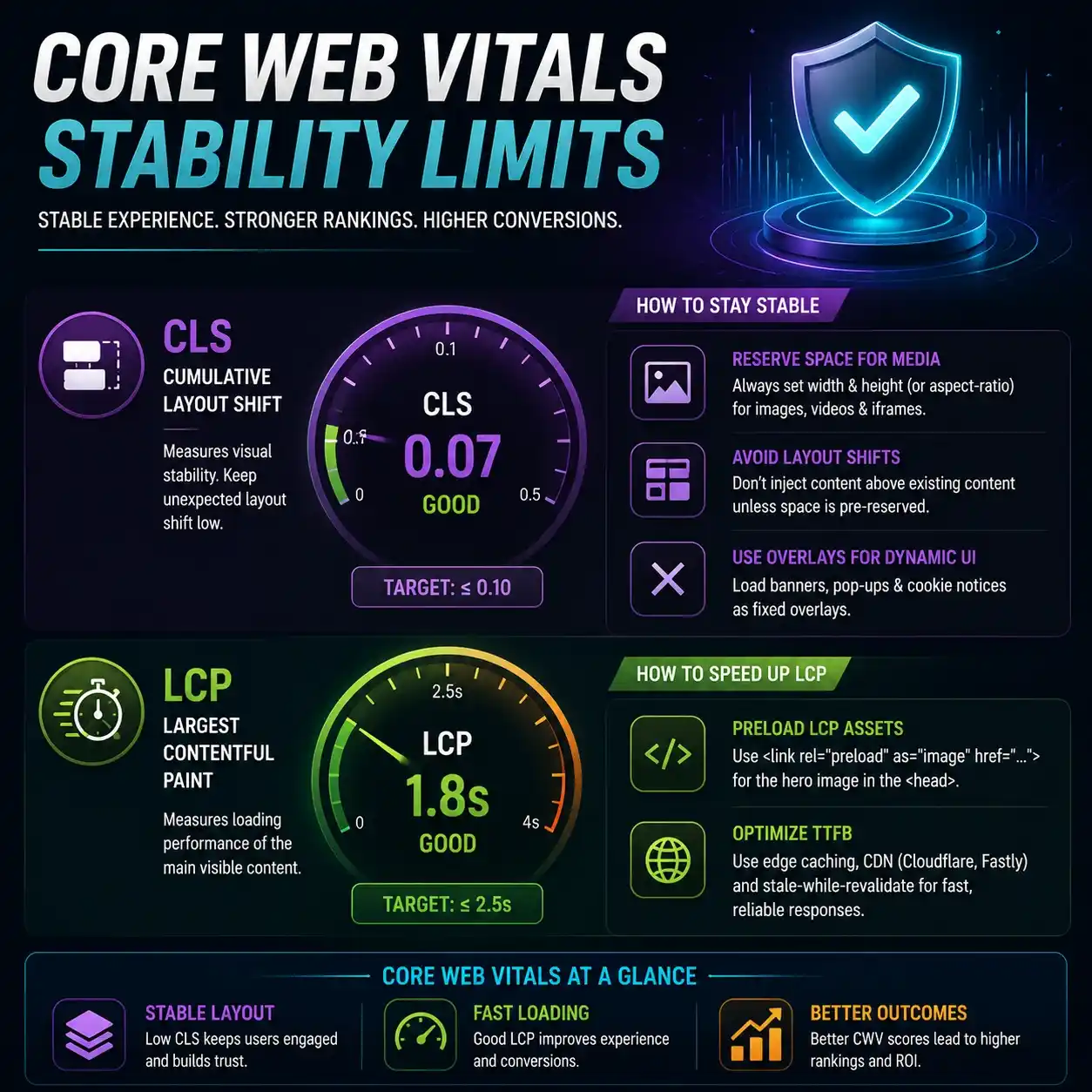
Beyond responsiveness, visual stability and immediate asset rendering dictate baseline search engine visibility and conversion efficiency.
Cumulative Layout Shift (CLS)
A high CLS score (exceeding 0.1) signals unexpected movement of elements within the viewport during rendering, which degrades user flow.
Media Dimensions: Explicitly declare width and height aspect-ratio attributes within the raw HTML for all images, video players, and third-party iframe embeds. This allows the browser to pre-allocate exact layout containers before the actual network payload is delivered.
Dynamic UI Injection: Never insert client-side injected elements, such as promotional banners, dynamic headers, or cookie consent pop-ups, above rendered content unless it occupies a pre-reserved structural slot. Alternatively, load these structural modifications strictly as absolute overlays with position: fixed.
Duda Blog
Largest Contentful Paint (LCP)
LCP tracks when the primary above-the-fold visual element (typically a hero banner or large editorial heading) becomes fully visible. To compress LCP below 2.5 seconds:
Asset Preloading: Add direct <link rel=”preload” as=”image” href=”…”> directives in the HTML document head for the exact LCP asset: this critical image never relies on native client-side loading=”lazy” attributes.
Time to First Byte (TTFB) Compression: Move asset caching closer to the user edge by utilizing an Advanced Edge Worker architecture on an enterprise CDN (e.g., Cloudflare, Fastly). Implement server-side stale-while-revalidate headers to serve compiled HTML instantly while asynchronously updating background data caches.
The 2MB Document Fetch Rule
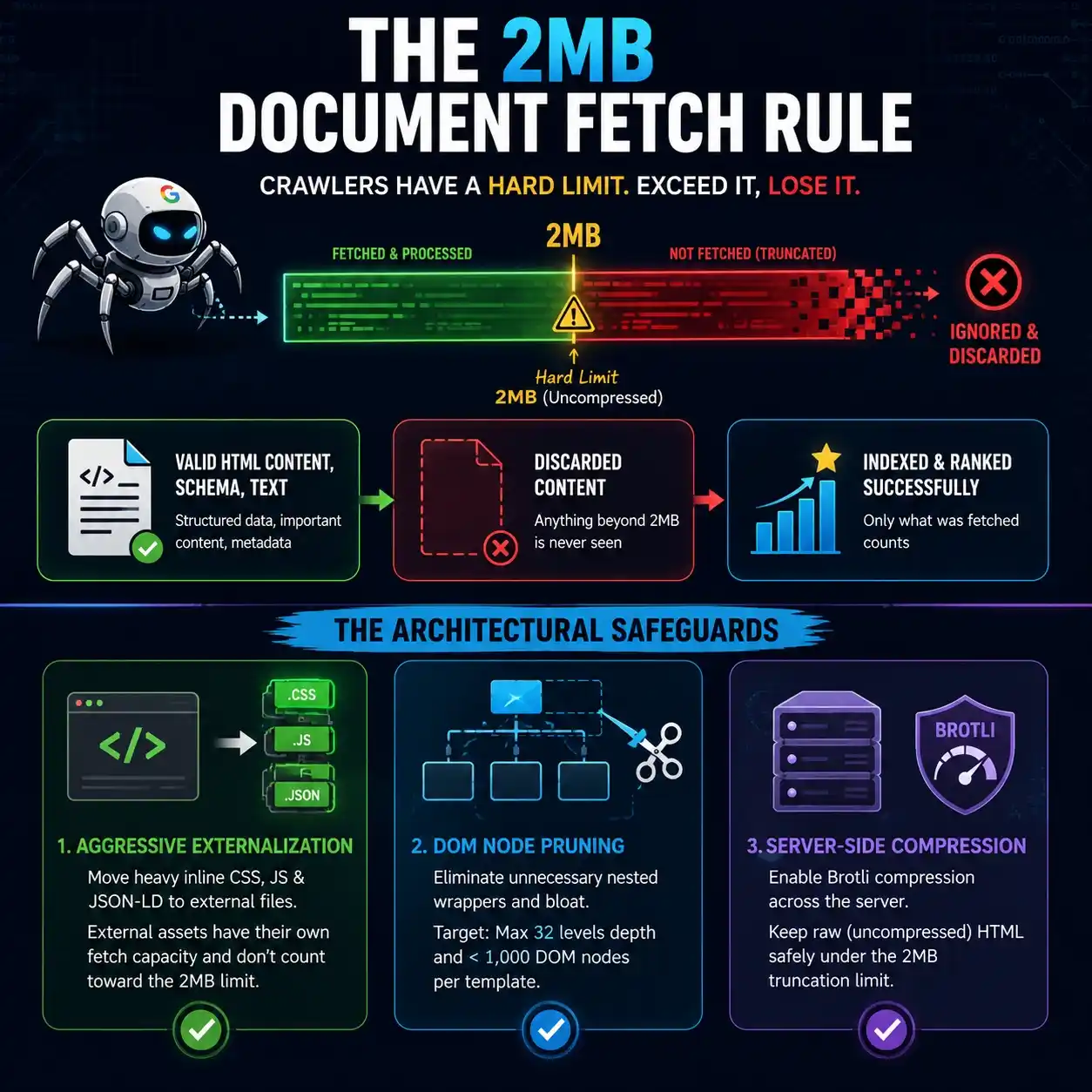
The HTML crawler responsible for indexing core content operates on a strict, unadvertised architectural constraint: partial fetching triggers silently at exactly 2MB.
If the raw, uncompressed server response (HTML payload including comprehensive embedded metadata and inline assets) crosses this 2MB limit, the crawler cuts off the download mid-stream. It processes whatever structural data it successfully captured up to that bit, discarding the rest of the document entirely.
| Valid HTML Content, Schema, Text | Discarded Content |
| Indexed and Ranked Successfully | Silent Index Drop |
The Architectural Safeguards
Aggressive Externalization: Strip out heavy inline CSS payloads and massive block JSON-LD schema configurations. House them within external cacheable stylesheets and script files. External referenced assets operate on their own independent fetch capacities and do not count against the primary 2MB document threshold.
DOM Node Pruning: Reduce structural bloat by auditing deep, unnecessary nested wrappers created by heavy page builders or unoptimized component nesting. Target a maximum DOM depth under 32 levels and total DOM nodes under 1,000 per template.
Server-Side Compression: Confirm Brotli compression is fully operational across your server configuration. While compression minimizes the wire transfer profile for human performance, optimization efforts should still keep the raw, uncompressed source code safely beneath the architectural truncation ceiling.
Hire SocialzRank for Expert Technical SEO
SocialzRank believes that technical infrastructure is the basis for sustainable growth. From optimizing crawl budget to improving Core Web Vitals, our experts resolve problems that are quietly destroying your rankings. Check out our professional SEO services designed specifically for businesses operating in the United States.
Frequently Ask Questions
Cheap agencies run free automated plugins that print out surface-level PDF reports. We perform deep server-log forensic analysis, rewrite unoptimized script execution lines, and manually fix complex indexing errors that generic tools miss entirely.
Technical corrections trigger rapid search responses. Once we resolve critical errors and force a recrawl via Google Search Console, you can observe indexation adjustments and ranking recovery within 7 to 14 days.
Because AI models are entirely dependent on clean data extraction, If your site suffers from broken layout rendering, messy schema code, or raw JavaScript text blocks, AI crawlers will skip your assets and cite a competitor instead.
No. AI tools are valuable for fast syntax checking, but automated code injection introduces script bloat. Our specialized engineers manually audit and streamline your rendering pipeline to protect site speed and bring stability.
We track backend metrics that dictate crawling efficiency and speed: Time to First Byte (TTFB), crawl budget utilization efficiency, Core Web Vitals health passes, and the elimination of 404/500 indexation drops.
Developers build for native functional execution, not for search engine discovery algorithms. We bridge that specific gap by translating algorithm requirements into actionable, clean tickets your engineering team can deploy immediately.
We require roughly 3 hours during the initial access and discovery phase. Once we deliver the prioritized technical optimization tickets, your team can deploy them in standard development sprints, or our engineers can execute them directly.
You own every clean line of code we deploy. Every optimized server configuration, custom schema script, and architectural blueprint remains completely yours. We keep clients through measurable growth, not restrictive legal traps.