


Table of Content
- Introduction
- The Reality of Organic Growth in 2026
- How Does Content Marketing Drive Enterprise Revenue?
- How Do You Write SEO Blog Posts That Rank on Google and Get Shared?
- Why Is YouTube Marketing for Business the Ultimate Distribution Multiplier?
- How Do You Build a Content Calendar Template That Product Teams Actually Execute?
- How Do You Repurpose Content to Extract 10x Value from a Single Asset?
- Why Are Generic Information Frameworks Burning Your Ad Budget?
- Why Is Premium Organic Visibility Worthless Without a Hard Conversion Engine?
Introduction
An enterprise content marketing strategy 2026 requires a fundamental shift away from generic volume generation toward hyper-targeted, high-intent asset engineering. To capture market share this year, brands must deploy a modular, multi-channel ecosystem that answers complex user intents within three seconds, balancing search engine optimization with immediate brand conversion value. This structural blueprint drives compounding customer acquisition by transforming standard informational inquiries into measurable pipeline revenue without relying on traditional paid ad channels.
The modern buyer profile demands instant technical clarity and absolute logical alignment, rendering shallow, top-of-funnel listicles completely obsolete. Companies scaling their organic reach in 2026 recognize that content is a capital allocation strategy, not a creative playground. Success hinges on hard product mechanics, deep user experience synchronization, and structured data execution that establishes absolute brand authority from the very first touchpoint.
The Reality of Organic Growth in 2026
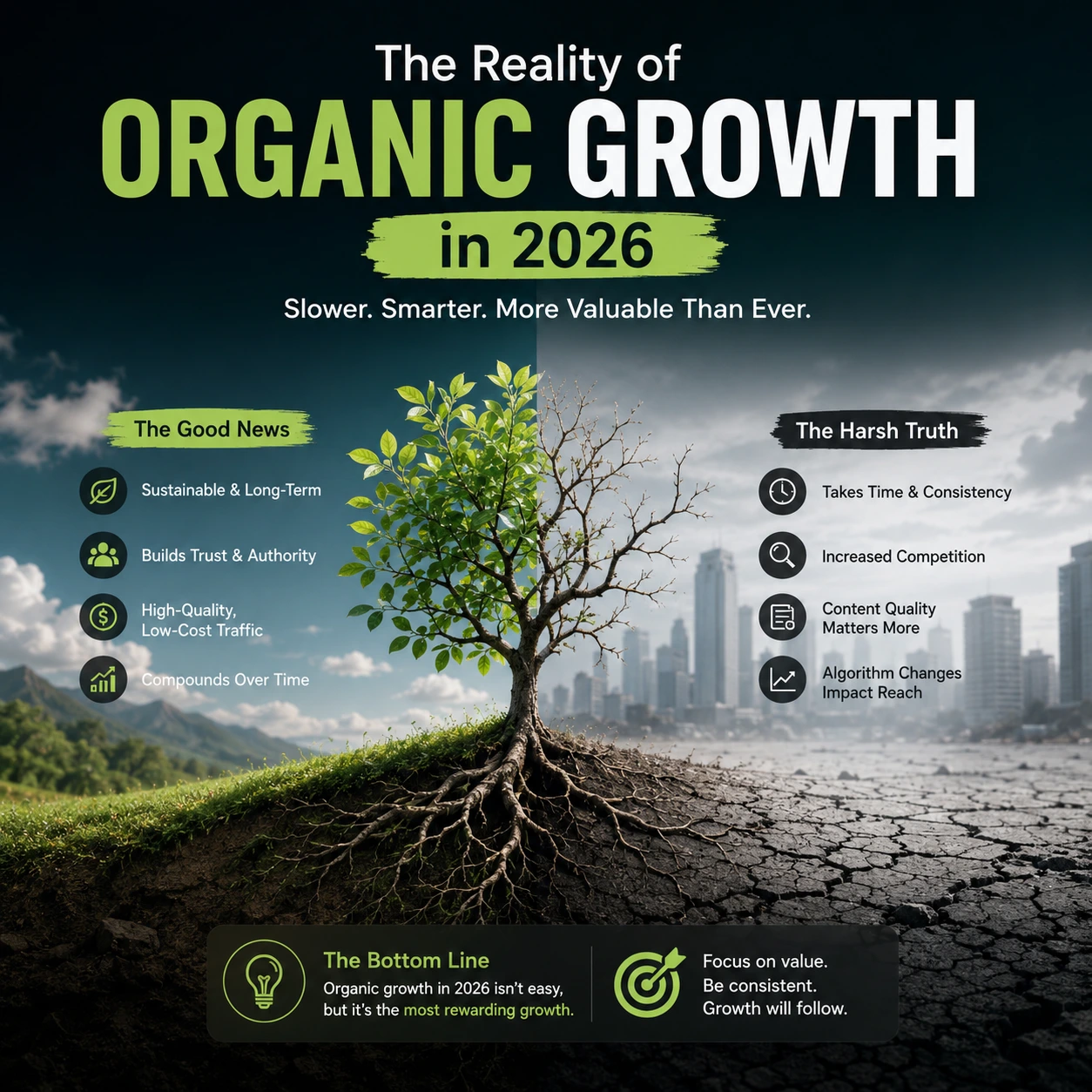
The contemporary distribution environment leaves zero margin for execution errors, lazy writing, or generic playbooks that simply repeat public definitions. Recent global market intelligence indicates that content industry revenue will reach $107.5B in 2026, meaning your brand is competing against well-funded, highly optimized information engines.
To break through this competitive noise, technical founders and product teams must stop publishing disconnected thoughts and start engineering a deliberate, multi-layered cluster network.
Every single paragraph in your brand asset must serve a dual purpose: first, it must satisfy the strict programmatic semantic parsing requirements of algorithmic discovery networks; second, it must present a completely original, unvarnished viewpoint that hooks the technical buyer. We achieve this by anchoring our arguments in verifiable math, precise product mechanics, and real-world interface challenges that display undeniable domain mastery.
How Does Content Marketing Drive Enterprise Revenue?
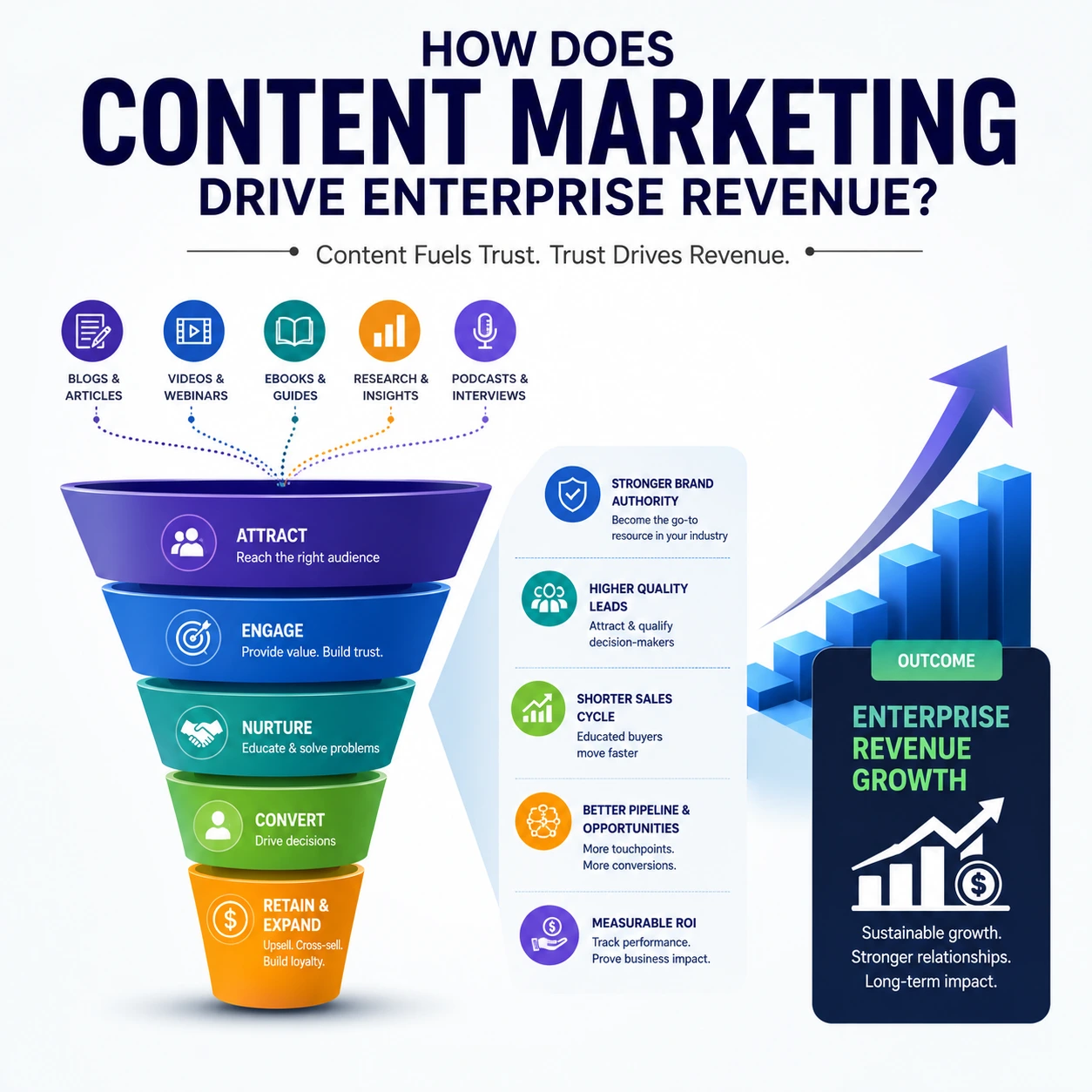
Content marketing is the strategic creation and distribution of valuable, relevant, and consistent material to attract and acquire a clearly defined audience to drive profitable customer action. In the current 2026 digital environment, content functions as the primary capital asset of your business. It outperforms traditional outbound marketing channels by generating three times the lead volume at 62% lower cost per acquisition.
While paid advertising stops delivering the moment your budget hits zero, high-quality content assets compound in value over time, creating a permanent organic traffic engine that fuels your pipeline without daily ad spend. For a full breakdown of what content marketing is and how it drives revenue, see What Is Content Marketing and How Does It Drive Revenue?.
Enterprise revenue hinges on the ability to demonstrate value before a single contract is signed. By answering complex customer questions, you eliminate sales friction and establish authority. Organizations that invest in comprehensive content programs report 67% more leads per month than those relying on static, sales-only websites.
The goal is not just traffic, but specific, high-intent traffic that enters your ecosystem already educated on your product mechanics. This shift in strategy lowers your customer acquisition cost (CAC) while increasing the lifetime value (LTV) of every user.
Key Takeaways:
Content marketing functions as a capital allocation strategy rather than an expense line item. It reduces dependency on paid search by capturing organic demand at a lower cost per lead. Long-term compounding value dictates that assets created today continue to produce revenue for years, making content the most efficient driver of scalable pipeline growth.
Short-Form vs Long-Form Content: Which Performs Better in Enterprise Funnels?
Choosing between short-form and long-form content is not a stylistic decision but a functional one. Short-form pieces (under 1,000 words) capture immediate attention on social platforms and mobile devices, but long-form content (2,000+ words) serves as the backbone of your SEO strategy.
Data indicates that posts exceeding 2,000 words earn 77% more backlinks than their shorter counterparts, which directly influences your domain authority and search visibility. Enterprise funnels rely on trust, and long-form guides provide the necessary depth to prove your expertise.
Long-form content reduces bounce rates by keeping users on the page longer, providing sufficient space to explore technical problems, offer solutions, and prove your unique methodology. While short-form content excels at top-of-funnel social engagement, it often fails to convert users who require deep education before purchasing.
Enterprise brands must utilize both, using short-form assets to distribute links that lead back to comprehensive, long-form pillar resources. This dual approach maximizes social reach while maintaining deep organic search performance.
Key Takeaways:
Long-form content acts as the primary driver for SEO rankings, backlinks, and domain authority. Short-form content serves as the delivery vehicle for mobile and social channel distribution. A high-performance strategy requires both, using short-form updates to funnel traffic into long-form pillars that build trust and drive high-intent conversions.
How Do You Write SEO Blog Posts That Rank on Google and Get Shared?

SEO blog posts are structured articles optimized with specific keywords, semantic intent, and technical metadata to rank higher in search engine results pages while providing actionable value to the reader. Ranking in 2026 requires more than just keyword insertion.
Google rewards topical authority and structural precision. Your content must answer the specific user query immediately, then expand into the nuanced, technical details that AI overviews and human researchers seek. If your article does not satisfy the search intent within the first three paragraphs, the algorithm pushes your ranking down.
For a step-by-step framework on creating content that ranks in search results and attracts more shares, read our guide on How to Write Blog Posts That Rank on Google and Get Shared?
The technical architecture of a top-ranking post requires a clear H2 and H3 hierarchy that maps to the questions your customers type into search bars. You must prioritize semantic relevance, using secondary keywords naturally within the context of expert analysis rather than forced repetition.
When you provide unique, data-backed insights, you force search engines to view your site as an authoritative industry source. This process transforms your blog into a product in its own right, attracting passive traffic that eventually qualifies itself as a lead.
Key Takeaways:
High-ranking SEO content prioritizes search intent over keyword volume. You must organize information using clear H2 and H3 headers that answer specific questions. Data-driven insights and original research increase the probability of earning backlinks, which remains the single most significant factor in long-term organic ranking success.
How to Write a Blog Introduction That Hooks Readers in 3 Seconds
The introduction is the most expensive piece of real estate on your website because it determines whether a user stays or leaves. Statistics show that the first 150 words of your article determine 70% of scroll depth likelihood.
If you open with a generic definition or a soft, fluffy paragraph, the reader exits immediately. You must deliver a direct, provocative statement that immediately validates the user’s intent. Tell them exactly what they will gain and why they should listen to your specific perspective.
Skip the background history and the long-winded setup. Start with a counter-intuitive fact, a bold claim about the current industry environment, or a clear promise of a technical solution. By front-loading the value, you signal to the reader that their time is respected.
This immediate delivery increases time-on-page metrics, which the algorithm interprets as a signal of high-quality content. Readers today have zero tolerance for filler. If you cannot hook them in three seconds, you have already lost the lead.
Key Takeaways:
The introduction must confirm search intent in the first three sentences. Avoid industry jargon or irrelevant fluff. Use direct, punchy, and valuable statements that promise a specific solution or outcome. Front-loading value signals quality to search algorithms and significantly reduces your bounce rate.
Why Is YouTube Marketing for Business the Ultimate Distribution Multiplier?
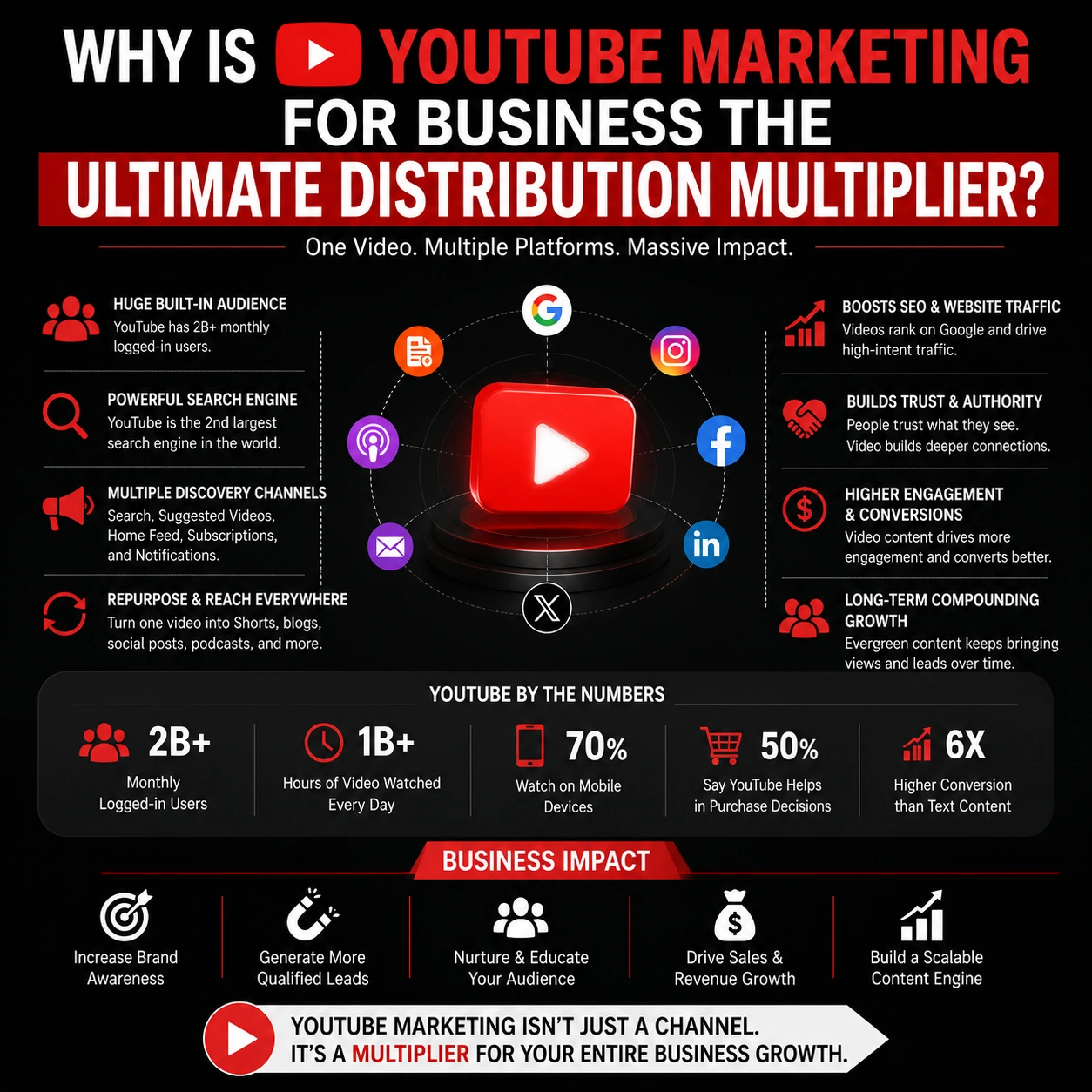
YouTube marketing is the systematic creation and optimization of video assets hosted on the YouTube platform to build brand authority, capture informational search intent, and drive qualified traffic into commercial funnels.
Deploying video content alongside a written content marketing strategy 2026 framework provides a distinct competitive advantage. Video assets build deep, human authority faster than text alone, capturing audiences who prefer visual demonstration over long-form reading. Because YouTube is the second-largest search engine in the world, optimizing video content allows your brand to dominate two separate search engine results pages simultaneously.
Integrating video assets directly into your digital footprint creates an ecosystem where text and visual media amplify each other. When embedded into corresponding articles, video assets increase the average time-on-page metric by up to 260%, signalling exceptional content quality to search engine crawlers. This dual-exposure strategy means a single topic can capture an executive reading an analytical report at their desk, as well as a technical founder listening to an industry teardown during a commute.
Key Takeaways:
Video Acceleration Video marketing captures an entirely separate audience segment that prioritizes visual and auditory learning. Embedding relevant videos into technical articles increases dwell time, directly boosting organic rankings. A unified approach across search engines maximizes brand real estate and creates multiple touchpoints for complex enterprise buyers.
How Often to Post Blogs and Videos to Maintain Compounding Algorithmic Authority?
Maintaining organic momentum requires an aggressive, predictable publishing cadence that balances velocity with technical depth. To build compounding algorithmic authority, enterprise brands should publish two high-value long-form articles and one optimized video asset per week.
High publishing frequency teaches search crawlers to index your domain more frequently, ensuring new pieces rank faster. However, publishing speed must never compromise quality; low-value content serves zero purpose and actively damages your search health.
Consistency overrides raw volume over a long time horizon. A predictable schedule signals reliability to both human audiences and search algorithms, creating an expectation of constant value. If resource constraints limit output, it is far better to publish one flawless, authoritative article every single week than to drop four low-quality, generic pieces in a single day. Map your production schedule directly to your internal engineering or design capacity to maintain a steady, unyielding flow of market insights.
Key Takeaways:
Velocity and Consistency Algorithmic authority relies on a regular, predictable publishing cadence that keeps search engine indexing bots returning to your site. High-quality production always takes precedence over pure volume. Establishing a consistent schedule builds trust with human audiences while steadily expanding your structural keyword footprint.
How Do You Build a Content Calendar Template That Product Teams Actually Execute?

A content calendar template is an operational framework or scheduling tool used by marketing and product teams to plan, track, and manage the production pipeline of media assets from ideation to final publication. Most calendars fail because they are designed by isolated marketing teams without understanding developer or designer workflows.
A successful system must integrate directly into existing project management software, utilizing clean kanban layouts or sprint-based timelines. This structural alignment ensures that content creation feels like a natural extension of the product roadmap rather than an administrative chore.
An executive-level template demands clear ownership metrics, hard deadlines, and immediate access to background research material. Define exactly who owns the research, the draft creation, the asset design, and the final search optimization step.
So, by treating asset creation with the same rigor as product development, you eliminate production bottlenecks and maintain your publishing speed. This operational clarity removes the friction that typically slows down cross-department collaboration.
Key Takeaways:
A content calendar template must match the native development workflows of your technical and product teams. Clear ownership and well-defined production phases prevent bottlenecks and keep projects moving forward. Treating media asset creation with the same discipline as code deployment results in a predictable production cycle.
The Best Content Formats for Lead Generation and Pipeline Acceleration
Capturing top-of-funnel traffic is completely meaningless if your media assets fail to convert readers into qualified sales pipelines. The highest-converting content formats include interactive tools, ROI calculators, technical whitepapers, and proprietary data indexes. These premium formats demand deep industry expertise and offer immense immediate utility, making readers highly willing to exchange their corporate contact information for access.
Static, generic eBooks no longer move the needle for sophisticated enterprise buyers who demand immediate, actionable answers. Focus on engineering assets that solve an active, real-time bottleneck for your target user, such as an open-source template or a comprehensive design system audit framework. When you deliver a functional tool that immediately optimizes their day-to-day workflow, you establish absolute commercial trust. This tactical validation accelerates the sales cycle, turning cold organic visitors into warm, high-intent accounts.
Key Takeaways:
Interactive tools and data-heavy whitepapers significantly outperform generic eBooks in high-value enterprise lead generation. High-intent assets must solve a specific, immediate problem for the target persona to justify the conversion. High-utility resources build deep trust, accelerating the transition from casual reader to active pipeline lead.
How Do You Repurpose Content to Extract 10x Value from a Single Asset?

Content repurposing is the systematic process of restructuring, formatting, and adapting a single foundational media asset into multiple distinct promotional elements across various distribution platforms to maximize reach and efficiency.
In the resource-constrained environment of 2026, relying on a single publication format is an expensive operational mistake. A comprehensive long-form pillar article represents dozens of hours of deep expert research. Failing to extract every ounce of value from that intellectual property means you are overspending on content creation while leaving massive traffic channels completely untouched on alternative platforms.
The mechanic behind high-yield asset adaptation relies on modular copywriting. When you build your primary long-form guide using distinct, data-dense blocks, you can easily separate individual sections into standalone pieces. A technical paragraph analyzing performance metrics can become an incisive post on professional networks.
A single case study inside your text block can serve as the script for a short video asset or a dedicated slide deck for industry presentations. This modular pipeline allows a lean marketing team to maintain a massive multi-channel presence without needing to constantly brainstorm new topics from scratch.
Key Takeaways:
Multiplier Mechanics Content repurposing transforms single research investments into multiple platform-specific assets to maximize distribution efficiency. Designing modular articles allows for instant adaptation into short updates, slide decks, or scripts. This systematic extraction reduces production costs while dramatically scaling your brand real estate across different channels.
How to Measure Content Marketing ROI Using Verifiable Financial Formulas
Calculating the financial return on investment of your marketing program requires moving away from soft vanity metrics like page views or social likes and focusing on hard pipeline attribution. The standard formula for content marketing ROI subtracts the total cost of production and distribution from the total organic pipeline revenue generated, then divides the result by the initial campaign investment.
To capture this data accurately, you must implement multi-touch attribution models that track an enterprise buyer from their initial anonymous search entry all the way to their final software contract signature.
Beyond the overarching return formula, product teams must isolate the customer lifetime value relative to the customer acquisition cost for organic channels. Organic search traffic consistently yields a higher lifetime value because these users actively search for a solution to their exact technical challenge, rather than being interrupted by a paid advertisement.
Measuring the cost of content production against the cost of equivalent paid advertising clicks reveals the true baseline value of your organic footprint. When an article ranks permanently for a high-intent keyword, it provides ongoing lead generation that reduces your paid ad dependency month over month.</p>
Key Takeaways:
Financial Attribution Content marketing ROI must be measured using hard pipeline revenu
e rather than superficial traffic metrics. Tracking long-term value requires multi-touch attribution systems that connect early content consumption to final revenue generation. Organic leads deliver superior financial returns due to their lower acquisition costs and higher overall retention rates.
Why Generic Information Frameworks Are Burning Your Ad Budget

Building a high-yield distribution framework requires moving past random acts of marketing and treating your media footprint as an interconnected product architecture. Deploying an engineering-focused content marketing strategy 2026 approach shifts your brand from a passive participant to an aggressive market leader. Recent enterprise tracking metrics reveal that the median SEO campaign return reaches a massive 748% over a three-year window when backed by rigorous, data-dense cluster structures. This financial reality proves that when you build structured informational assets, you are creating long-term business equity that scales independent of traditional ad budgets.
The Brutal Reality of Technical User Acquisition
By aligning every heading to deep user intents and completely removing fluff, you position your brand as the definitive authority in your space. The technical buyer does not look for generic summaries; they seek unvarnished logic, clear product mechanics, and instant solutions. Securing market share this year demands that you execute your production calendar with absolute operational discipline, treating text and media as a unified conversion pipeline.
Why Is Premium Organic Visibility Worthless Without a Hard Conversion Engine?
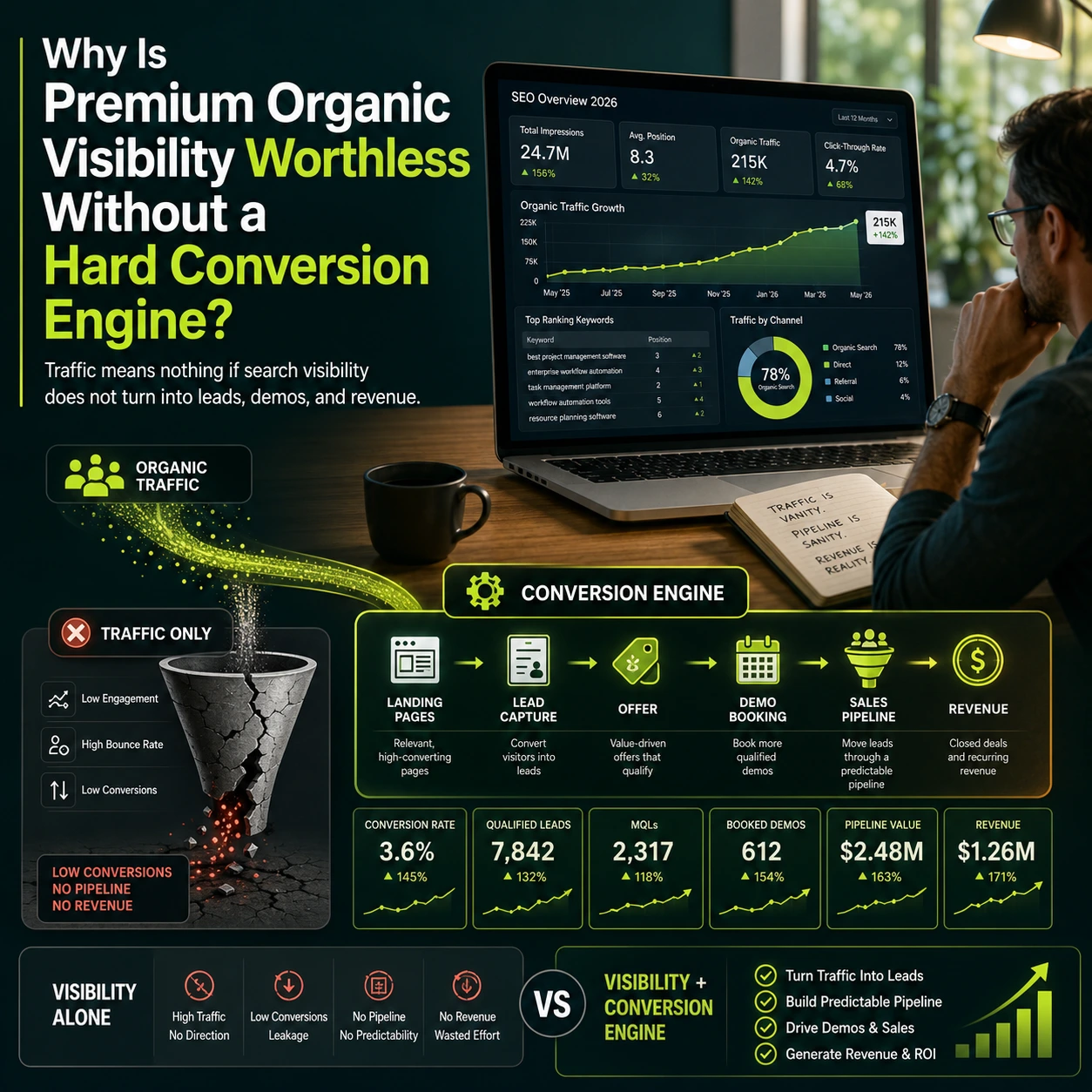
Capturing high-intent enterprise organic traffic is only half the battle; the real victory lies in converting those technical readers into
qualified, scaling sales pipelines. At SocialzRank, we eliminate the disconnect between search discoverability and aggressive revenue acquisition. We engineer high-yield digital marketing strategies, conversion-focused content frameworks, and dominant search authority campaigns that transform cold organic clicks into active, paying enterprise accounts.
le=”font-weight: 400;”>Our specialized digital marketing agency coordinates your entire distribution footprint with absolute technical precision, building high-performing lead generation engines that reflect your deep domain expertise. Let us take over your digital customer acquisition and scale your organic visibility infrastructure. Partner with SocialzRank today
Frequently Ask Questions
Onboarding friction directly degrades your organic conversion metrics and inflates user acquisition costs. You measure this drag by tracking the drop-off percentage at each individual interface step, then multiplying that lost user volume by your average customer lifetime value. If a multi-step form drops twenty percent of qualified signups, that single interface barrier represents a direct reduction in your total marketing pipeline yield.
A highly profitable corporate footprint utilizes an eighty-twenty distribution model, favoring informational search queries. Eighty percent of your architecture must target deep, educational, and problem-solving terms to capture users early in their research phase. The remaining twenty percent targets direct commercial intent keywords, providing an immediate path for educated users to transition straight into a sales conversation.
Search engine bots allocate a specific crawl budget to your domain based on structural depth and update velocity. Flat site architectures, where no critical content asset sits more than three clicks away from the root homepage, ensure rapid indexing. Deeply buried pages suffer from delayed crawling, meaning your fresh technical data takes significantly longer to rank on search engine results pages.
Technical buyers seek deep structural context and comprehensive logic rather than shallow summaries. Bullet points frequently oversimplify complex systems, stripping away the necessary engineering nuances that technical founders use to validate domain expertise. Expanding technical arguments into dense, scannable prose paragraphs demonstrates true operational capability and retains high-intent readers on the page longer.
Maximizing asset distribution velocity requires deploying next-generation image formatting, aggressive browser caching rules, and global content delivery networks. You must eliminate render-blocking script elements and minimize total layout shifts during the initial paint cycle. Fast infrastructure lowers bounce rates among mobile users, signaling exceptional user experience to algorithmic indexing engines.
You locate semantic gaps by scraping search queries from competitor domains and cross-referencing those keywords against your internal asset catalog. Look for long-tail technical phrases where search engines are forcing low-quality forums or outdated resources into the top spots. These ranking anomalies reveal a complete lack of authoritative industry guides, offering an immediate opening for your brand to dominate the topic.
Interactive tools like calculators or sandbox simulators generate up to forty percent higher conversion rates than static downloadable text files. Enterprise buyers prefer immediate, personalized utility over reading generic industry predictions. Engineering a lightweight functional asset provides instant value, making users significantly more willing to exchange their verified corporate information for access.
Keyword cannibalization occurs when multiple separate URLs on your domain target identical search intents, forcing search algorithms to choose between your own assets. You prevent this by assigning one definitive pillar post to the primary high-volume keyword phrase. Every supporting cluster post must target a unique, non-overlapping secondary long-tail query, linking directly back to the main pillar page using specific anchor text.