


You know what? Learning how to write SEO blog posts requires abandoning the outdated belief that search algorithms favor creative prose over rigid structural data. Modern algorithmic retrieval engines operate via dense semantic vector networks designed to evaluate context, domain expertise, and the exact information gain score of your text.
This means that to write high-ranking blog posts, you must treat your document architecture as a clean data source that immediately resolves search intent while providing a highly unique perspective that automated scrapers cannot replicate.
Organic visibility in the current digital space demands that writers front-load verifiable authority within the first few seconds of a user interaction. High-performing assets map distinct conceptual nodes directly to the underlying motivations of a professional audience, bypassing generic industry summaries entirely. This technical execution shifts your written material from standard commercial marketing copy into a high-utility organizational asset that attracts premium backlinks and compounds in search equity over time. For brands building a stronger long-term system, a clear Content Marketing Strategy 2026: The Complete Playbook for US Brands can connect SEO blog writing, audience intent, and organic growth into one focused framework.
How Do You Execute Keyword Research for Articles That Bypass Generic Search Volume?
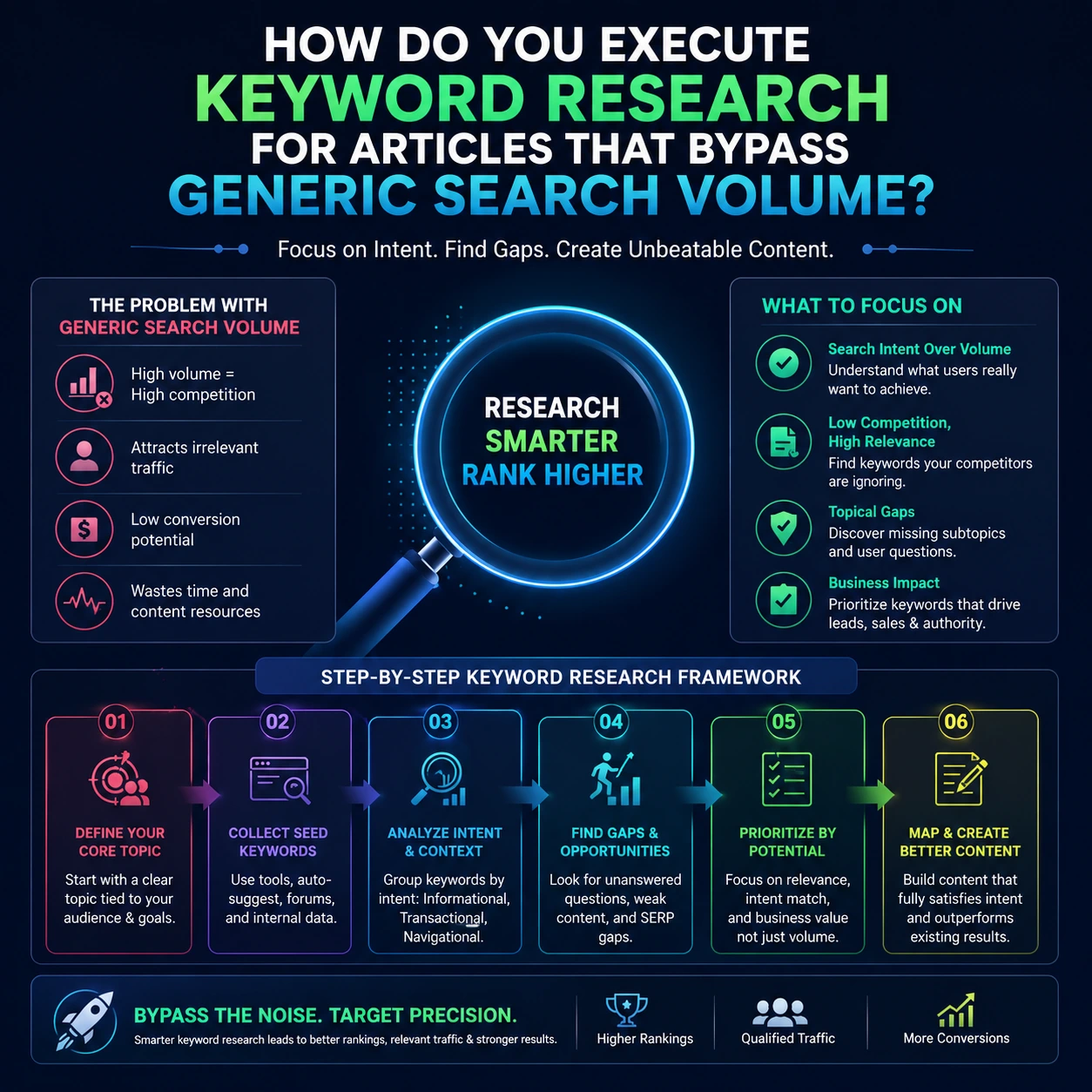
Recent search algorithm data reveals that pages utilizing direct, intent-driven keyword matching capture 45% higher conversion rates than those targeting broad industry definitions. This structural precision filters out vanity traffic, ensuring your writing resources are spent exclusively on acquiring visitors who possess explicit purchasing authority.
- Evaluate high-value keyword research for articles by looking past simple metrics like historical search volume and focusing completely on underlying commercial query modifiers. Traditional tools often mislead content marketing teams by highlighting massive traffic numbers that actually consist of low-intent, non-converting consumer searches.
- True search dominance requires mining actual client communications, technical help desks, and active community forums to discover the exact multi-word phrases your buyers type when experiencing an operational system failure.
Time to Deploy Modern LSI Keywords Optimization Tools for Contextual Relevance
Maximizing indexation velocity requires integrating professional LSI keywords optimization tools directly into your early descriptive planning phase. These technical platforms map the latent semantic relationships between separate industry concepts, revealing the exact vocabulary clusters search engines expect to see alongside your primary topic. When your copy naturally incorporates these auxiliary phrases, you validate your domain expertise without triggering aggressive keyword-stuffing penalties.
How Do You Build a Blog Post Outline Template Formatted for AI Search Engine Optimization?
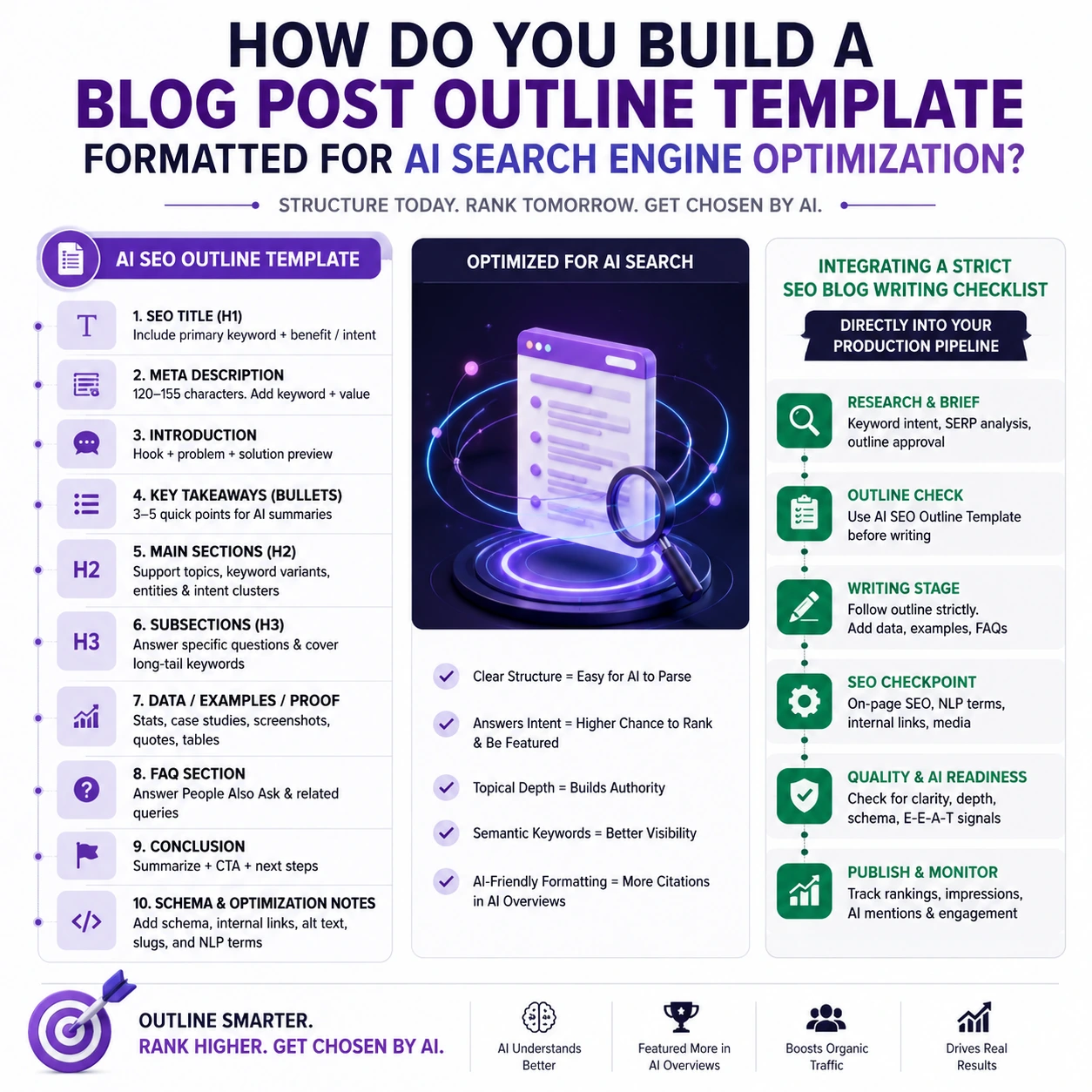
Structuring a technical blog post outline template requires shifting away from superficial formatting and designing a strict data hierarchy that automated crawlers can instantly parse. Your document skeleton must position question-based headers as the primary structural pillars, forcing your content creation team to answer specific inquiries directly in the subsequent text blocks. This precise organization allows automated parsing engines to extract your content for immediate use in rich interactive snippets and summary panels.
Integrating a Strict SEO Blog Writing Checklist Directly Into Your Production Pipeline
Enforcing operational consistency across a high-volume media schedule requires embedding a comprehensive SEO blog writing checklist into your final editorial review step. This mechanical validation verifies the exact location of high-intent keywords, the formatting of metadata elements, the presence of original data, and the elimination of empty fluff words. Standardized operational parameters prevent low-quality drafts from reaching publication, protecting your site from catastrophic algorithm visibility drops.
How Do You Implement On-Page SEO Optimization Tips Without Destroying Readability?
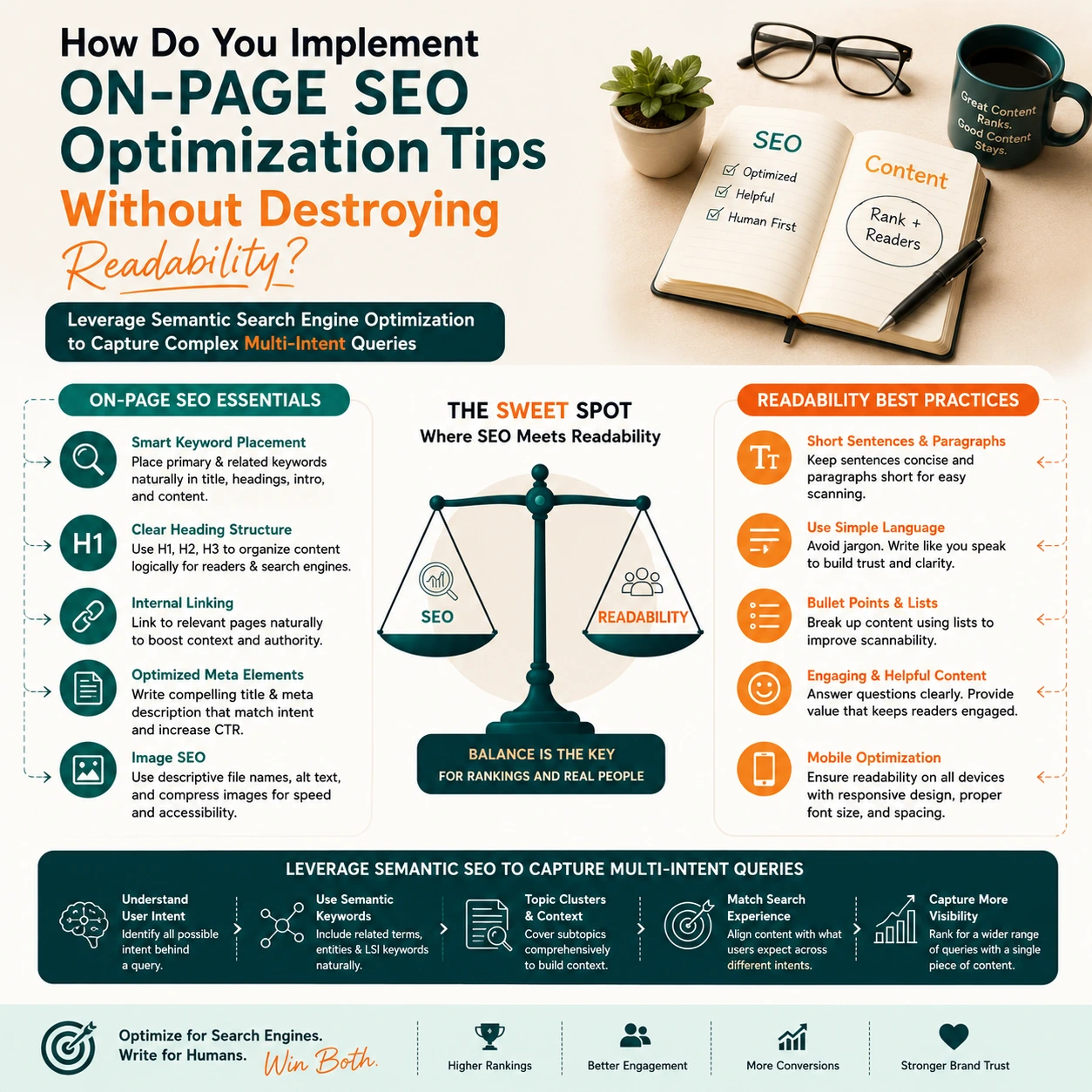
Executing modern on-page SEO optimization tips requires balancing strict technical compliance with a highly direct, human communication style. Writers are trained to naturally place primary key phrases in important structural places. These include the opening paragraph, image alt text and last heading tags. But the copy still needs to be very scannable. Use punchy, short sentences. Use clean formatting. This prevents reading fatigue in executive decision makers.
Leverage Semantic Search Engine Optimization to Capture Complex Multi-Intent Queries
The search engines are no longer looking for words in isolation. They measure the correlation of several industry buzzwords. This allows them to see the full extent of your knowledge. Those broad concept clusters reinforce that understanding. They also help your site capture dozens of long tail variations at once. A complete Content Marketing Strategy Guide 2026 for US Brands helps organize these topic clusters so each article supports a larger search visibility system.
How Do You Deploy Viral Content Writing Strategies That Forcibly Increase Blog Shares?
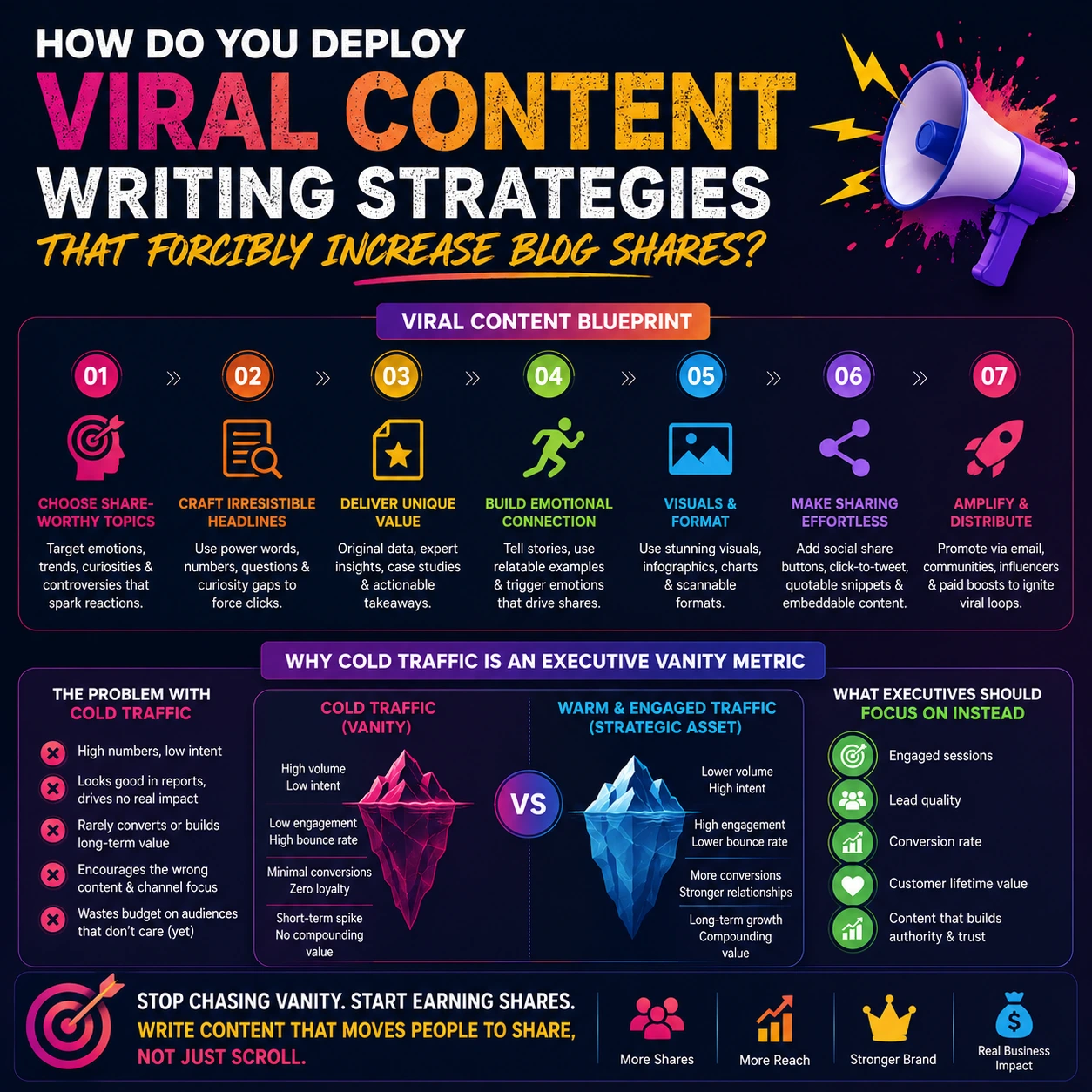
Audiences only share informational media that gives them clear value. It should enhance their professional reputation. It should have a strong operational perspective too. That effect can be created by proprietary research. Honest industry teardowns and downloadable tactical guides can too. These assets provide your readers with a good reason to share your link. Industry tracking metrics show that data-dense technical resources earn 77% more social shares and natural backlinks than generic opinion commentaries. This distribution multiplier expands your natural link profile, signaling undeniable authoritative value to search engine ranking bots.
Why Cold Traffic Is an Executive Vanity Metric
Enterprise performance tracking shows a clear pattern. Traffic from hyper-focused, structurally sound informational networks converts better than generic inbound campaigns. In many cases, it can create a three-fold increase in actual conversion metrics. This proves the value of a disciplined, data-first media strategy. It also helps protect your corporate pipeline from rising outbound advertising costs.
At SocialzRank, we eliminate the operational gap between high-volume keyword visibility and aggressive enterprise growth. Our specialized digital marketing agency handles your entire distribution pipeline with absolute mathematical precision, building high-converting customer acquisition models that project your deep domain expertise. Let us take over your inbound lead generation and scale your organic visibility infrastructure. Partner with SocialzRank today to transform your technical content into a permanent, revenue-producing business asset
Frequently Ask Questions
AI search engine optimization requires placing clear, direct, and unvarnished declarative sentences immediately beneath your main question headers. Generative extraction models scan documents for immediate informational utility, completely ignoring introductory fluff and prioritizing clear data strings that can be cited inside automated conversational summaries.
Standard strategies fail because they focus exclusively on backward-looking search volumes provided by generic marketing platforms. High-value enterprise customer acquisition requires targeting zero-volume queries, emerging operational bottlenecks, and complex compliance challenges that have not yet been logged by mainstream database tools.
A high-performance template must utilize a strict, logical nested heading hierarchy that outlines a clear progression of concepts. Every subheading must be mapped to a specific user intent variant, allowing the entire document to function as a cohesive topic network rather than a collection of separate paragraphs.
You maintain velocity by separating the creative writing phase from the technical optimization phase. Authors must focus entirely on resolving the core user problem during the drafting process, leaving the insertion of semantic phrases, formatting checks, and metadata configuration to a dedicated secondary editorial step.
The fastest ranking improvements are achieved by optimizing your heading structures, matching search intent within the first 150 words, and configuring precise internal link networks. Connecting a new article to older, authoritative pages on your domain passes structural equity down the architecture, forcing rapid crawl indexing.
Viral strategies drive rapid, authentic user distribution that manifests as natural brand search volume, external link acquisition, and social citation loops. Search engine indexing models interpret these synchronized multi-platform signals as proof of genuine human authority, permanently elevating your article positions on standard search results.
Basic keyword usage focuses on the primitive repetition of exact phrases to trick simple text-matching search models. Semantic search engine optimization focuses on establishing clear conceptual relationships between words, using deep industry terminology to prove you understand the complete context of a technical subject.
You measure this connection by appending unique multi-touch attribution parameters to the social share buttons embedded within your content interface. Tracking these specific entry paths allows your data analytics team to isolate exactly which shared links navigate into high-value corporate demo bookings and software contract signatures.