

Table of Content
- Introduction.
- 10 Shocking Stats: The 2026 SEO Reality Check.
- What Is SEO and Why Does It Matter for Your Business?
- On-Page SEO: A Step-by-Step Checklist for Beginners.
- Technical SEO: What It Is and How to Fix Common Errors.
- How to Build Backlinks That Google Actually Trusts.
- Local SEO: How to Rank on Google Maps in Your City.
- The 1% Rule: Why Most SEO Strategies Are Built to Fail in 2026.
- Why SocialzRank is the Only SEO Partner You’ll Ever Need.
Introduction
SEO guide for businesses USA is the strategic process of aligning your digital presence with the specific search behaviors and algorithmic shifts of the United States market to capture high-intent traffic. In 2026, this means moving beyond simple keywords and optimizing for “Search Generative Experience” (SGE) and local intent to ensure your business appears exactly where your customers are looking. If you aren’t visible on page one today, your business effectively doesn’t exist to the 93% of Americans who start their buying journey with a search bar.
Quick Expert Insight for Readers:
Search Engine Optimization (SEO): SEO is the practice of increasing the quantity and quality of traffic to your website through organic search engine results. It is the art of making your business the most relevant answer to a user’s specific problem.
10 Shocking Stats: The 2026 SEO Reality Check
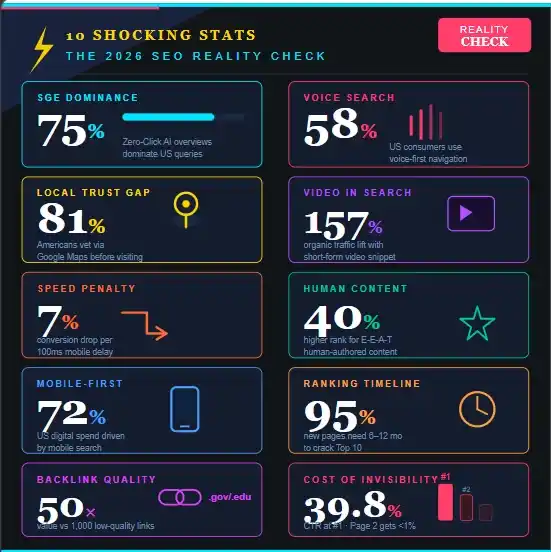
SGE Dominance:
By mid-2026, 75% of informational queries in the USA are answered directly within the search results page via AI overviews, making “Zero-Click” optimization a mandatory survival skill.
Voice Search Volume:
58% of US consumers now use voice-first navigation (Siri, Alexa, Gemini) to find local service businesses, shifting the focus from short-form keywords to natural language patterns.
The Local Trust Gap:
81% of Americans use Google Maps to “vet” a business before visiting, meaning your local SEO strategy is now your primary digital storefront.
Video in Search:
Results containing a short-form video snippet are seeing a 157% increase in organic traffic compared to text-only results in the 2026 Google landscape.
The Speed Penalty:
For every 100 milliseconds of delay in mobile load time, US e-commerce conversion rates drop by 7%, cementing technical SEO as a financial priority.
Human-Centric Content:
Following the 2026 “Authenticity Update,” content that demonstrates clear personal experience (E-E-A-T) ranks 40% higher than generic, unedited AI-generated blogs.
Mobile-First Spending:
72% of all US digital ad and organic spend is now driven by mobile-specific search behavior, making “desktop-first” design a legacy mistake.
The Ranking Timeline:
95% of new pages take at least 6 to 12 months to rank in the Top 10 for competitive US keywords, proving that SEO is a marathon, not a sprint.
Backlink Quality over Quantity:
A single link from a high-authority US (.gov or .edu) or niche-specific domain is now 50x more valuable than 1,000 low-quality “directory” links.
The Cost of Invisibility:
Businesses ranking in the #1 spot on Google captures 39.8% of all click-through traffic, while businesses on Page 2 receive less than 1% of total clicks.
Key Takeaways:
- Adapt or Die: SEO in 2026 is about AI readiness and meeting the user where they speak (voice/SGE).
- Local is King: If you serve a US city, Google Maps is your most important asset.
- Data is Non-Negotiable: Speed, mobile-friendliness, and authentic experience are the pillars of the current algorithm.
What Is SEO and Why Does It Matter for Your Business?
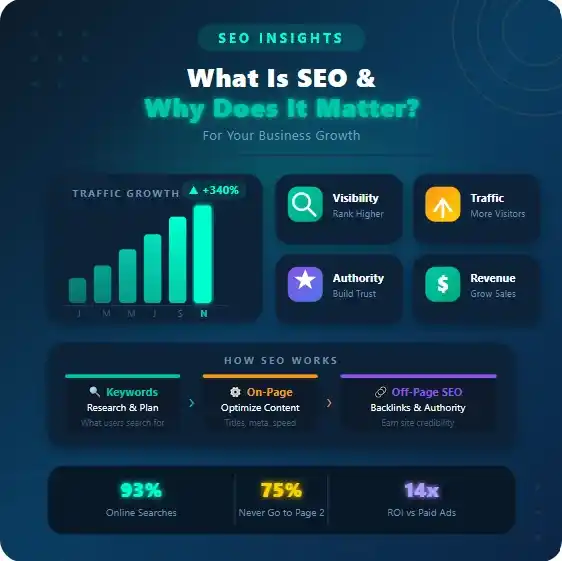
What is SEO? It is the strategic alignment of your website with the intent of your target audience and the requirements of search algorithms to earn visibility without paying for ads. It matters because it is the only marketing channel that builds compounding digital equity; while paid ads stop working the second you stop paying, SEO continues to funnel high-intent customers to your site 24/7. In the competitive USA market, being the “best” at what you do is irrelevant if search engines can’t verify your authority. For a deeper breakdown of its business impact, see our detailed guide on What Is SEO and Why Does It Matter for Your Business?.
Quick Expert Insight for Readers:
Search Intent: The underlying goal or reason why a user types a specific query into a search engine. Common types include Informational, Navigational, Transactional, and Commercial Investigation.
How Long Does SEO Take to Show Results?
how long does SEO take depends entirely on your domain’s current authority and the competitiveness of your niche. For most businesses in the USA, you will see initial “signals” (ranking improvements and impressions) within 3 to 4 months, but true ROI, where organic leads consistently outpace your previous benchmarks, typically hits the 6-to-12-month mark. In 2026, the “sandboxing” effect is real; Google needs time to trust that your content isn’t just a flash-in-the-pan AI generation.
Free vs Paid SEO Tools: Which One Should You Use?
Deciding between free SEO tools USA, like Google Search Console, and paid powerhouses like Ahrefs or Semrush isn’t an “either/or” scenario. Free tools are non-negotiable for monitoring your actual performance on Google’s own turf. But SEO software requires payment to learn about your competitors’ tactics and content possibilities. When you have a limited budget, start with Google Search Console and Google Keyword Planner, then move on to SEO software once you have enough funds.
Key Takeaways:
- Equity vs. Rent: SEO is owning your traffic; ads are just renting it.
- Patience is a Weapon: Expect a 6-month lead time for significant revenue shifts.
- Tool Synergy: Use free tools for your data and paid tools to steal your competitor’s data.
To understand this comparison in depth, read our guide Free vs Paid SEO Tools: Which One Should You Use?
On-Page SEO: A Step-by-Step Checklist for Beginners
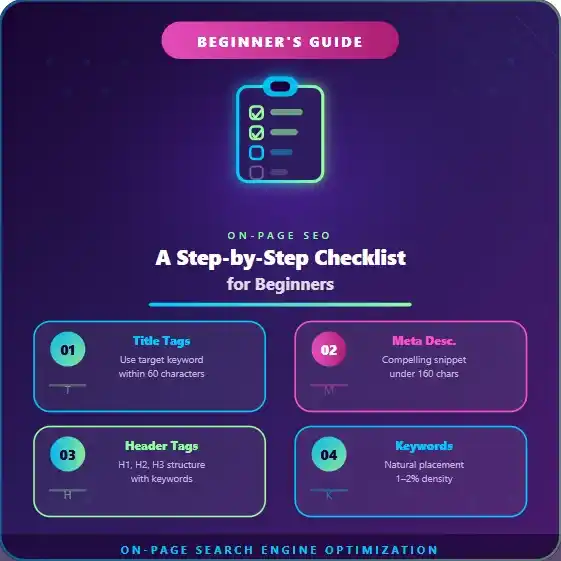
An on-page SEO checklist is a systematic process of optimizing individual web pages to rank higher and earn more relevant traffic. It’s about making your page incredibly easy to “read” for both humans and bots. If your H1 doesn’t match the user’s query and your images don’t have alt-text, you are essentially burying your best content in a digital vault. In 2026, on-page optimization isn’t just about keywords; it’s about topic coverage and satisfying the user’s next three questions before they even ask them. For a practical breakdown, follow this On-Page SEO: A Step-by-Step Checklist for Beginners to implement these optimizations correctly on your website
Quick Expert Insight for Readers:
Metadata: Snippets of text that describe a page’s content; they don’t appear on the page itself, but in the page’s code (e.g., Meta Titles and Meta Descriptions seen on Search Result Pages).
How to Do Keyword Research for a Small Business Website
Mastering keyword research small business means ignoring the high-volume “vanity” terms and hunting for “long-tail” gold. Instead of trying to rank for “shoes” (impossible), you should target “orthopedic running shoes for flat feet in Brooklyn.” These specific queries have lower competition and much higher conversion rates. Use tools to find “People Also Ask” questions: these are the direct pain points your customers are typing into Google right now.
If you want a practical step-by-step breakdown of how to apply these techniques, read our guide How to Do Keyword Research for a Small Business Website.
Why Is My Website Not Ranking on Google?
If your website not ranking Google is a persistent nightmare, it usually boils down to three “spicy” truths: your content is a boring copy of someone else’s, your site is technically broken, or you have zero “social proof” (backlinks) from other sites. In 2026, Google also heavily penalizes “thin content”, pages that provide generic answers without adding new value or unique perspectives. If you’re stuck on Page 5, it’s likely because you’re answering the question, but not solving the problem.
Key Takeaways:
- Structure Wins: Use clear H2s and H3s to guide the “skimmer” reader.
- Long-Tail is Life: Small businesses win by being specific, not by being general.
- Value or Die: If your page looks like every other result, Google has no reason to promote you.
If you want a deeper breakdown of these ranking issues, read our guide Why Is My Website Not Ranking on Google?
Technical SEO: What It Is and How to Fix Common Errors
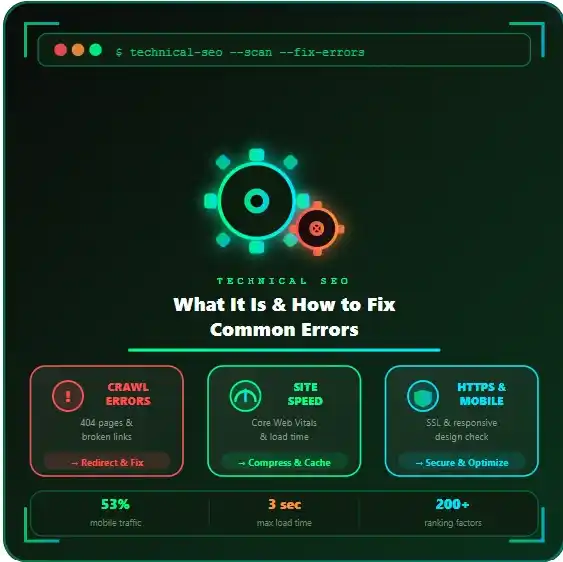
A technical SEO guide is a manual for ensuring search engines can access, crawl, and index your website without hitting a digital wall. Think of it as the foundation.
ion of a skyscraper; if it’s cracked, it doesn’t matter how beautiful the penthouse is: the whole thing is going to collapse. In 2026, technical SEO has shifted from “nice-to-have” to “survival-of-the-fastest.” If your site’s code is bloated or your mobile response is sluggish, Google will prioritize a leaner competitor every single time. For a step-by-step approach, see our Technical SEO Guide: What It Is and How to Fix Common Errors.
Quick Expert Insight for Readers:
Crawlability & Indexability: Crawlability refers to the search engine’s ability to access and move through your site’s pages. Indexability is the engine’s ability to analyze that page and add it to its database (the index). </span>
Google Algorithm Updates: What They Mean for Your Rankings
Understanding a Google algorithm update 2026 is about realizing that Google’s goal is to serve the most helpful, human-centric answer possible. The major updates this year, like the March Core and Spam updates, specifically targeted “scaled content abuse” (mass-produced, low-value AI junk). If your rankings take a hit, it’s usually a signal that your site is lacking E-E-A-T (Experience, Expertise, Authoritativeness, and Trustworthiness). Don’t panic and change everything at once; instead, audit your content for original data and real-world expertise that a bot simply can’t replicate.
Key Takeaways:
- Performance is a Ranking Factor: Load speed isn’t just for users; it’s for bots.
- AI is a Tool, Not a Strategy: Use AI for outlines, but ensure the final “voice” is undeniably human to survive core updates.
- Security is Standard: If you aren’t on HTTPS in 2026, you’ve already lost.
To understand these updates in detail and how they impact rankings, read our guide Google Algorithm Updates 2026: What They Mean for Your Rankings.
How to Build Backlinks That Google Actually Trusts
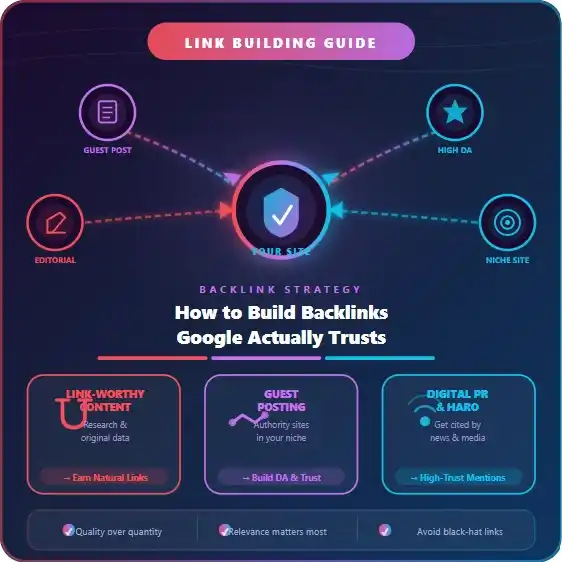
A backlink building strategy is the process of getting other high-authority websites to link to your content, acting as a “vote of confidence” in the eyes of search engines. However, the days of buying 5,000 links on a shady forum are long dead. In 2026, Google values editorial relevance over sheer volume. One link from a reputable US-based industry magazine or a .gov resource is worth more than a million links from random “link farms.” It’s about building a digital reputation, not just a list of URLs.
Quick Expert Insight for Readers:
Domain Authority (DA): A search engine ranking score that predicts how likely a website is to rank on search engine result pages (SERPs). While not a direct Google metric, it is a vital industry benchmark for link-building.
Digital PR: The Modern Way to Earn Authority
The “hot” facts about link building in 2026 are quite straightforward: It’s digital PR. Instead of asking for links, you craft “link bait” such as data studies, calculators, or industry reports that journalists want to link to. When you become the primary source for a statistic (e.g., “The average cost of SEO in Texas 2026”), the links happen naturally. This creates a “moat” around your business that competitors can’t simply buy their way across.
Broken Link Building: The Helpful Shortcut
One of the most effective ways to build trust is by helping site owners.
ners fix their own mistakes. Find high-authority pages in your niche that link to dead or outdated content. Then reach out and offer your own high-quality, up-to-date page as a replacement. It’s a win-win: they fix a broken user experience, and you earn a powerful backlink from a trusted domain.
Need to create backlinks that get rewarded by Google in 2026? Discover how you can do this in our comprehensive guide entitled How to Create a Google-Approved Backlink Building Strategy.
Key Takeaways:
- Quality Over Everything: 1 great link > 1,000 bad ones.
- Be the Source: Create original data to earn links while you sleep.
- Relevance is the Filter: Only chase links from sites that actually make sense for your industry.
Local SEO: How to Rank on Google Maps in Your City
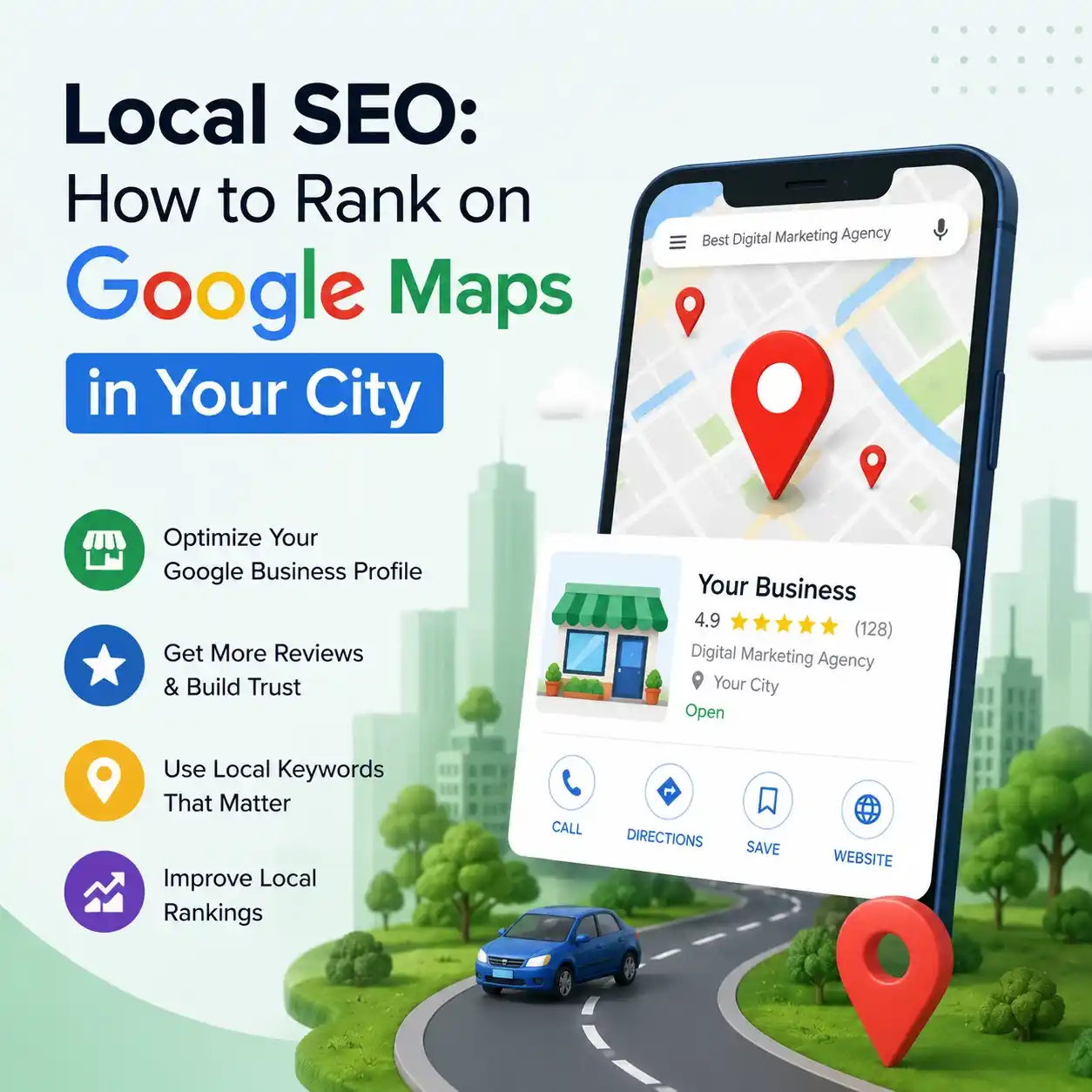
A local SEO strategy is the specialized optimization of your digital presence to attract customers from a specific geographic area. In the USA, this revolves almost entirely around the “Map Pack”: the top three results that appear alongside a map in Google Search. Ranking here isn’t just about keywords; it’s about proximity, prominence, and relevance. If your business information is inconsistent across the web or you lack recent, high-quality reviews, you are handing your local market share directly to your competitors. For a step-by-step walkthrough, see our Local SEO: How to Rank on Google Maps in Your City.
Quick Expert Insight for Readers:
NAP Consistency: NAP stands for Name, Address, and Phone Number. Consistency across all digital platforms (Yelp, Google Business Profile, Facebook, etc.) is a critical signal Google uses to verify your business’s legitimacy.
Optimizing Your Google Business Profile (GBP)
Your Google Business Profile is your second homepage. To dominate your city in 2026, you must do more than just fill out the basics. You need to treat it like a social feed: upload high-resolution photos weekly, respond to every single review (both good and bad), and use the “Posts” feature to share offers or updates. Google prioritizes active profiles that prove the business is alive and engaging with the community.
The Power of Local Citations and Reviews
Reviews are the digital currency of trust in the USA. The firm having 40 five-star reviews can outrank another firm that has 500 four-star reviews since Google gives preference to review quality over quantity.
Key Takeaways:
- The Map Pack is the Goal: Most local clicks happen in the top 3 map results.
- Activity Equals Visibility: An abandoned GBP profile is a ranking killer.
- Reviews are Proof: Encourage customers to use specific service keywords in their reviews for an extra SEO boost.
The 1% Rule: Why Most SEO Strategies Are Built to Fail in 2026
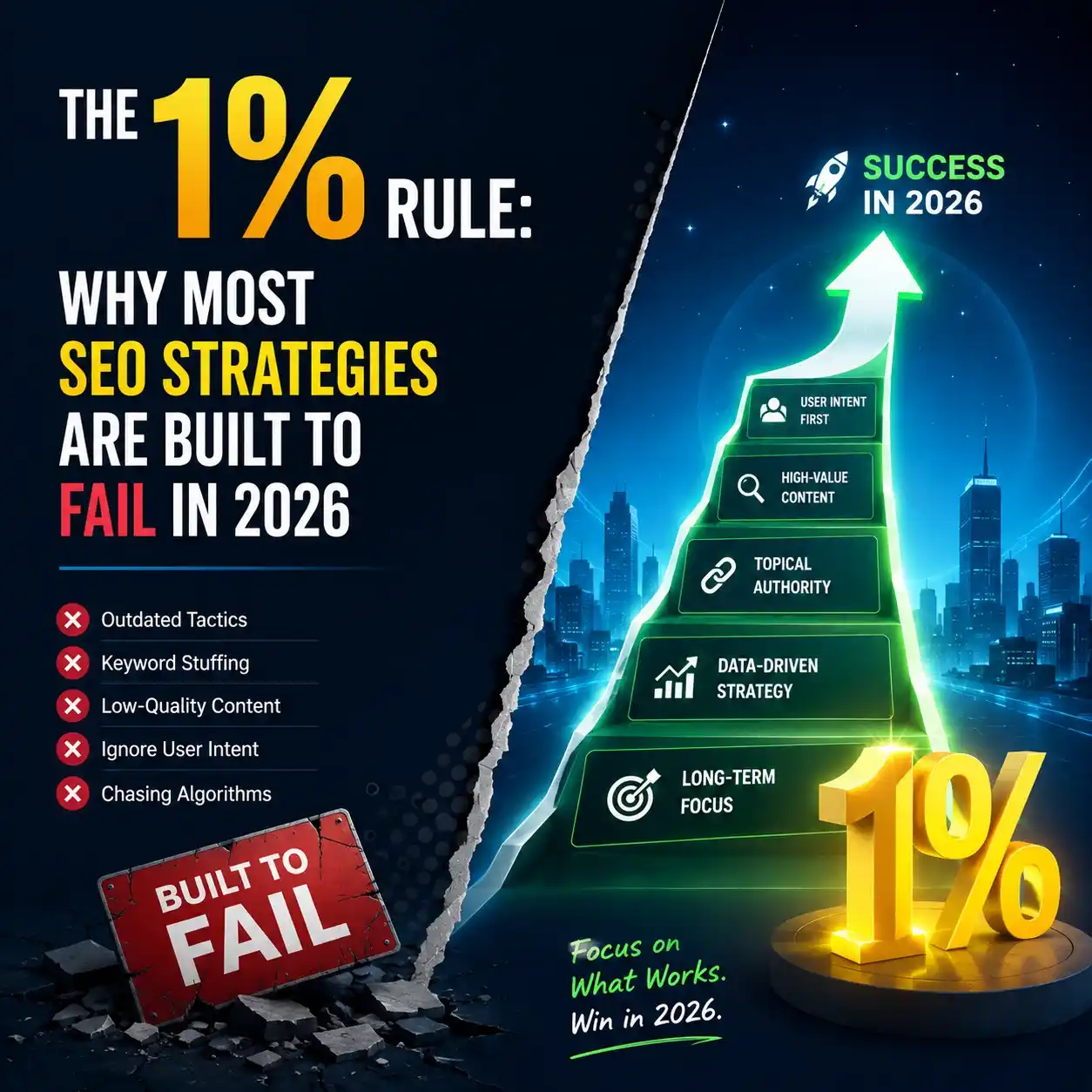
The 2026 search engine battleground is no longer a place for “good enough” content or slow, bloated websites. It is a winner-take-all environment where the top 1% of businesses capture nearly all the organic revenue. Navigating the complexities of SGE, voice search, and hyper-local algorithms requires a shift from viewing SEO as a “marketing expense” to seeing it as a core business asset.
Your competitors have made it onto the Map Pack but your website remains on page 2? It’s time to stop making assumptions. There’s no need for trickery when you can show search engines why your website is the most trustworthy option for your clients.
Why SocialzRank is the Only SEO Partner You’ll Ever Need
At SocialzRank, we don’t just “do SEO”: we engineer authority. We specialize in taking businesses across the USA and transforming them into topical leaders that search engines can’t ignore.
While other companies rely on 2018 strategies, we focus on 2026. We use predictive analysis, conversion architecture, and digital PR to dominate the search rankings.
Furthermore, our expert team solves the “invisible” problems that kill your ROI. No matter if it’s a technical audit that unlocks dormant traffic or a backlink strategy that builds a fortress around your brand, SocialzRank is where high-intent search meets high-impact results.
Ready to stop being invisible? Let’s build your digital empire.
Frequently Ask Questions
Look beyond "vanity metrics" like raw traffic. Real success is measured by organic conversion rates, "Keywords in Top 3" growth, and a reduction in your Customer Acquisition Cost (CAC) over time. If your traffic is up but your phone isn't ringing, you're ranking for the wrong things.
Raw, unedited AI content is a death sentence. However, using AI as a "research assistant" to build outlines and data sets is standard practice. The key is the Human-in-the-Loop model: every piece of content must have unique human insights and E-E-A-T to survive Google’s spam filters.
Yes, but not for "lifestyle" updates. A blog is a keyword-targeting machine. It allows you to answer the hundreds of informational questions your customers have, which builds the topical authority necessary to rank your main service pages.
Don’t panic. Sudden drops usually mean Google has adjusted how it weighs "helpfulness" or "authority" in your niche. Conduct a deep audit of your top-performing pages: are they fast? Are they mobile-friendly? Do they actually solve the user's problem better than the current Top 3?
You can handle the basics, like GBP updates and simple on-page tweaks, yourself. But to beat established competitors in the USA, you need the technical expertise, expensive tool stacks, and high-level PR connections that only a dedicated agency like SocialzRank provides.
User Experience (UX). Google tracks how users behave once they click your link. If they "pogo-stick" (immediately hit the back button), Google knows your page failed. High dwell time and low bounce rates are the ultimate signals of quality.
Not directly, but there is a massive indirect benefit. High social engagement drives traffic and brand awareness, which leads to more people searching for your business by name: a powerful authority signal that Google definitely tracks.
At least once every 6 months. A Google algorithm update 2026 prioritizes "freshness." Updating a high-ranking post with new stats, better images, and updated FAQs is often more effective than writing a brand-new post from scratch.